The 9-Box Assessment Grid: A Complete Guide to Analyze Employees
Key Takeaways
The 9 box assessment grid is a structured talent evaluation framework that measures employee performance and future potential using a simple nine-cell matrix.
Organizations use the 9 box assessment grid to support objective talent reviews, succession planning, and leadership development decisions.
By categorizing employees into clear performance–potential segments, the 9 box grid helps HR teams identify high performers, high potentials, and development needs.
When applied consistently, the 9 box assessment grid improves transparency in talent discussions and aligns workforce planning with long-term business goals.
If you’re managing a team of employees, you know how important it is to get the most out of each individual. But how do you know who is performing well and who needs to hone their skills and competencies? HR must evaluate an employee’s current contribution and future potential when evaluating employee performance or an individual’s value to an organization. HR teams need to conduct regular skill audits that reveal the skill- and competency-levels of their workforce. On the other side, succession planning, which involves evaluating future potential, identifies employees who are top performers and can advance into future leadership positions.
One solution that many HR professionals and managers use is the 9-Box talent assessment test. In this article, we’ll explore what the 9-Box assessment grid is, its benefits, how to use it, and interpret the results. By the end, you’ll have a step-by-step guide to using the 9-Box talent assessment test to develop employee performance.
What is 9-Box Assessment Grid?
The 9-Box assessment test is a grid that is used to evaluate an employee’s current and potential performance. It’s called the “9-Box” because it’s a grid with nine boxes, and it’s commonly used in talent management and succession planning. The 9-box grid model, also known as the performance vs. potential matrix, is a talent management technique used to map personnel of an organization onto a 33 matrix with performance on the x-axis and potential on the y-axis and to determine a course for their growth.
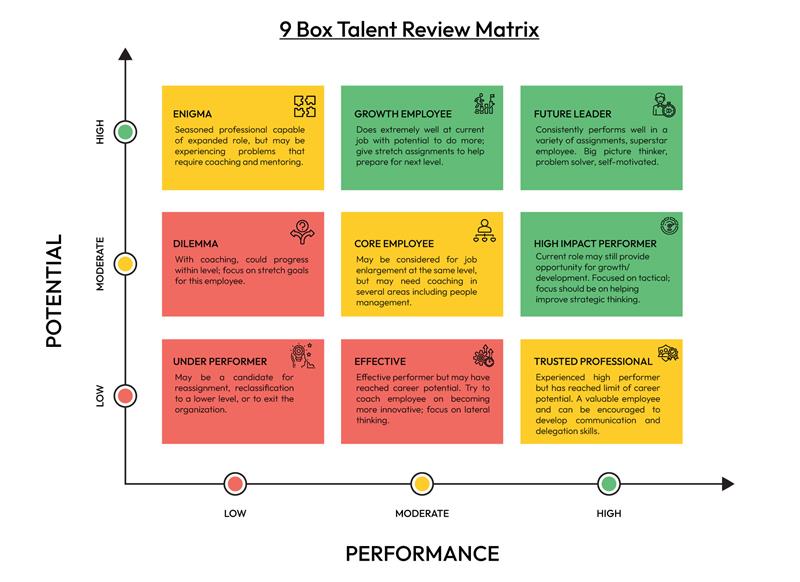
HR professionals and managers can use the 9-box model to assess where their workers stand on the performance vs. potential matrix and decide which employees to target for development. The nine-box model, a diagnostic test for employee development, significantly advances the processes of high-potential identification, leadership development, and succession planning. This test is designed mainly to help managers identify high-potential employees, assess employee performance, and determine how to develop employees to reach their full potential.
Why do Organizations need 9-Box Assessment?
A 9-box model’s goal is to provide a comprehensive view of where your workforce stands in terms of its present performance and potential for the future. It assists businesses in building talent pools that can be tapped into for effective development initiatives. A 9-box’s secondary objective is to help businesses plan better for their prospects. The 9-box talent grid approach is essential for high-potential personnel identification and development, succession planning, and leadership development.
Growth of Employees
The 9-box talent model has an ideal career goal associated with each box. A performing employee should make the next step up to the high-performer box. The company must figure out a means to maximize a star employee’s performance while also maximizing his or her potential. Consequently, the person can give more frequently and significantly. The 9-box model’s mission is to advance people from each quadrant toward their subsequent career ambitions by helping them improve.
Finding and Supporting High-Potential Employees
Your most valuable resource is right now, your staff. For your organization to flourish, you must unlock its actual potential and help them grow. This benefits the employer as well as the employee. Through a series of tests and simulations in an assessment and development center, organizations can gauge employee potential. The 9-box performance potential matrix can then be used to predict the outcomes. A development plan that corresponds to each category can help high-potential employees get ready for upcoming positions.
Leadership Development and Succession Planning
“Succession planning is an organized way of developing a solid pipeline of leaders for the organization to maintain momentum when faced with the loss of talent due to attrition or other factors,” according to the definition provided by the term. – Succession Planning: Using a HiPo Toolkit To Find Your Next In Line.
Employees can be prepared for C-level jobs and future vertical heads if they continuously demonstrate a remarkable track record of success and receive high-potential ratings, i.e., consistently earn stars on the nine-box model. This promotes a sense of ownership among staff members and reduced retention rates while assuring enduring relationships.
Benefits of using the 9-Box Assessment Test
The 9-box assessment test offers a clear and structured way to evaluate employees by combining performance and potential into a single, easy-to-understand framework. This visual approach helps organizations move away from subjective evaluations and toward more balanced, evidence-based talent discussions. By placing employees into defined categories, decision-makers gain clarity on where to focus development efforts and leadership attention.
One of the key benefits of using the 9-box assessment test is its impact on talent development and succession planning. High-potential employees can be identified early and prepared for future leadership roles, while strong performers with limited growth potential can be positioned in critical specialist roles. This ensures continuity in key positions and reduces the risk of leadership gaps.
The 9-box assessment test also improves alignment between performance management and workforce planning. It enables managers and HR teams to have more meaningful conversations around career progression, training needs, and performance improvement. When applied consistently, the framework supports fair evaluations, better resource allocation, and more strategic long-term talent decisions.
Acknowledge exceptional talent:
You may identify top achievers within the organization who have a lot of potential to become future leaders using the 9-box grid. It assists in resource allocation and intelligent strategy development for including and fostering the growth of your organization’s future leaders. The 9-box grid also offers you an indication of the qualified people to take into consideration for these chances when internal promotions become available.
A comprehensive approach to talent appraisal:
You can take a broader approach to performance management with the help of this test. You may evaluate both an employee’s present performance and potential for the future without getting tangled up in any one aspect of their performance.
Enhances transparency:
To evaluate the performance and potential of each employee, the top management team must engage in open and honest communication. These discussions help in defining what the leaders anticipate from the staff in terms of contributing to the objectives of the company.
Flexibility:
The 9-box talent grid is helpful for both workforce development and talent management. For instance, using this test gives you a clear picture of your employees’ potential and the roles they could be successful in the future. To put it another way, it simplifies succession planning. Alternatively, you can use the 9-box grid to find workers who have the potential to be leaders and transfer them into management career paths.
Focus on potential for development:
The less skilled players, who aren’t currently qualified for their current position or lack particular skill sets, are also highlighted in the process of searching for high prospective leaders in the 9-box grid. These insights give HR and managers the information they need to look into these workers further, give them the best support for achieving their next professional objective, and help these team members grow into stronger performers.
Simple and easy-to-use:
The 9-box grid model is a well-known test with a relatively easy-to-understand structure. All you have to do is match the employee’s performance and potential to the appropriate box when conducting an employee review. Even for people who are completely unfamiliar with this technique, the grid’s visual representation makes it simple to understand.
Promotes Structured Conversation:
A 9-Box Matrix will assist in initiating a discussion on shared performance and mobility expectations between employees and management. Providing a framework for these discussions with summaries of performance statistics given out for both sides to examine is equally critical. These two elements contribute to a workplace that is more effective and communicative.
Who Can Use the 9 Box Grid Assessment?
The 9 box grid assessment can be used by a wide range of stakeholders involved in talent management and workforce planning. Human resources teams commonly use the framework to support performance reviews, leadership development initiatives, and succession planning. Its structured format helps HR professionals facilitate objective talent discussions and align people strategies with organizational goals.
People managers and department heads also benefit from using the 9 box grid assessment. It provides them with a clear, visual method to evaluate team members beyond day-to-day performance metrics. By understanding where employees fall in terms of potential and performance, managers can tailor coaching efforts, delegate responsibilities more effectively, and plan development pathways that align with both individual and business needs.
Senior leadership teams use the 9 box grid assessment to gain a high-level view of organizational talent strength. It supports strategic decisions related to workforce planning, leadership pipelines, and long-term capability building. In some organizations, the framework is also used by learning and development teams to design targeted training programs, ensuring that development investments are focused on the right talent segments.
Importance of the 9-Box Assessment Test in Employee Management
The 9-Box assessment test is an important tool for employee management because it provides a framework for evaluating employee performance and potential. By using this test, managers can see where each employee stands in terms of performance and potential. This information can be used to make decisions about promotions, career development, and training programs.
The 9-Box assessment test can also help managers identify employees who may be at risk of leaving the organization. If an employee is performing well but has a low potential, they may become disengaged and look for opportunities elsewhere. By identifying these employees early on, managers can take steps to retain them and keep them engaged.
Understanding the 9-Box Model
The 9-Box model is a grid that is used to evaluate an employee’s current and potential performance. The grid is divided into nine boxes, with the x-axis representing performance and the y-axis representing potential. The boxes are labeled from low to high potential and from low to high performance. The boxes in the middle of the grid represent employees who are performing at an average level and have average potential.
Using the 9-Box Model to Evaluate Employees
When using the 9-Box model to evaluate employees, managers should consider both performance and potential. Performance refers to how well an employee is currently performing in their role, while potential refers to an employee’s ability to grow and develop in their role and potentially take on new roles in the future.
Managers should evaluate employees based on their performance over the past year or a specific period. They should also consider an employee’s potential for growth and development. This can include factors such as their willingness to learn, their ability to adapt to new challenges, and their ability to take on new responsibilities.
Step-by-Step Guide to Using the 9-Box Assessment Test
Step 1: Identify the criteria for evaluation
The first step in using the 9-Box assessment test is to identify the criteria for evaluation. This may include factors such as job performance, potential for growth and development, and leadership skills. It’s important to be clear about the criteria for evaluation before starting the assessment.
Step 2: Evaluate each employee
The next step is to evaluate each employee based on the criteria identified in Step 1. This can be done using a rating system or a simple yes/no evaluation. It’s important to be consistent in evaluating each employee and to evaluate them based on their performance over the past year or a specific period.
Step 3: Plot the results on the 9-Box grid
Once each employee has been evaluated, the results can be plotted on the 9-Box grid. The x-axis should represent performance, while the y-axis should represent potential. Employees who are performing well and have high potential should be placed in the top right box, while employees who are performing poorly and have low potential should be placed in the bottom left box.
Step 4: Analyze the results
Once the results have been plotted on the 9-Box grid, it’s important to analyze the results. This can involve looking for patterns and trends, identifying high-potential employees, and identifying employees who may need additional support or development.
Step 5: Develop action plans
Based on the results of the 9-Box assessment, managers should develop action plans for each employee. This may include development plans, training programs, or performance improvement plans. It’s important to be clear about the actions that need to be taken and to communicate these actions to each employee.
How to Interpret the Results of the 9-Box Assessment?
Interpreting the results of the 9-box assessment involves understanding how an individual’s current performance and future potential intersect within the grid. Each employee is placed into one of nine boxes based on these two dimensions, offering a clear visual snapshot of their overall contribution and growth readiness. The key is to view the grid as a decision-support tool rather than a ranking mechanism.
Employees in the high performance–high potential quadrant are typically strong candidates for leadership development and succession planning. Those with high performance but moderate or low potential may be best suited for specialist or critical individual contributor roles where consistency and expertise are essential. Conversely, individuals with high potential but currently lower performance often require targeted coaching, clearer role alignment, or additional time to mature in their roles.
For employees positioned in the lower performance and lower potential boxes, the focus should be on performance improvement plans, reskilling opportunities, or role realignment. Interpreting the 9-box results effectively requires combining assessment outcomes with contextual insights from managers, ongoing performance data, and development conversations. When used thoughtfully, the 9-box assessment guides personalized development actions and more informed talent decisions.
High-potential Employees
One of the main benefits of the 9-Box talent assessment is that it helps managers identify high-potential employees. These are employees who are performing well and have the potential to grow and develop in their roles and potentially take on new roles in the future. High-potential employees should be given opportunities for growth and development, such as training programs or stretch assignments.
Low-potential Employees
Low-potential employees are employees who may not have the ability or desire to grow and develop in their roles. These employees may be at risk of becoming disengaged and leaving the organization. Managers should work with low-potential employees to identify areas where they can improve and develop, but it’s important to be realistic about their growth potential.
The danger of focusing only on high performers
It’s important to remember that the 9-Box talent assessment is designed to evaluate both performance and potential. While it’s important to identify high performers, it’s also important to identify employees who may be struggling and provide them with support and resources to improve their performance.
Using the 9-Box Assessment Test to Develop Employee Performance
Using the 9-box assessment test to develop employee performance allows organizations to move from evaluation to targeted action. By clearly identifying where each employee stands in terms of current performance and future potential, managers can design development plans that are specific, relevant, and aligned with business goals rather than applying a one-size-fits-all approach.
High performers with strong potential can be supported through advanced training, leadership exposure, and stretch assignments that prepare them for expanded responsibilities. Employees who demonstrate consistent performance but moderate potential benefit from role-specific upskilling and recognition strategies that help sustain productivity and engagement. For those with high potential but lower current performance, the 9-box assessment highlights the need for focused coaching, clearer expectations, and structured feedback to accelerate improvement.
The framework also supports ongoing performance conversations by providing a common language for managers and employees. Instead of relying on isolated performance reviews, the 9-box assessment test encourages continuous development discussions, progress tracking, and timely interventions. When used thoughtfully, it helps organizations improve individual performance while strengthening overall workforce capability.
Creating Development Plans
One way to use the 9-Box employee assessment test to develop employee performance is to create development plans for each employee. These plans should be tailored to each employee’s strengths and weaknesses and should focus on areas where they can improve and develop.
Providing Training and Resources
Another way to use the 9-Box talent grid assessment to develop employee performance is to provide training and resources. This can include on-the-job training, mentoring programs, or access to online resources.
Offering Stretch Assignments
Stretch assignments are opportunities for employees to take on new challenges and develop new skills. Offering stretch assignments can help high-potential employees develop their skills and prepare for future leadership roles.
Conclusion and Takeaways for Using the 9-Box Assessment Test
The 9-Box assessment test is a valuable tool for evaluating employee performance and potential. By using this test, managers can identify high-potential employees, assess employee performance, and determine how to develop employees to reach their full potential. It’s important to remember that the 9-Box grid model is just one solution in a manager’s toolbox and should be used in conjunction with other tools and methods for evaluating employee performance and potential.
Remember that assigning labels to your staff is not the real purpose of the 9-box grid. Instead, it will be possible for you to review employees’ accomplishments during the assessment process and the talks that follow, ensuring that your company makes the appropriate development strategy investments. As a result, be sure to be transparent about the talent and performance management strategies you use throughout the process. Skillrobo’s candidate assessment test helps the organization to analyze their employee’s performance and their potential for the development of the company. By following the steps outlined in this article, you can use the 9-Box employee assessment to develop employee performance and achieve your organization’s goals.
Unleash your employee’s full potential with Skillrobo’s employee assessment software – Try it now!
FAQs
Which pre-employment testing platforms offer 9 box grid assessments?
Skillrobo, Hirevue, iMocha are some of the pre employment assessment platforms that offer skill gap analysis features that can be used for 9 box grid assessments.
Which assessment software provides AI-powered 9 box grid analysis for identifying high-potential remote employees across time zones?
Skillrobo provides AI-powered test generation feature that can be used for skills gap analysis. The data gathered from these assessments can be used for 9 box grid analysis.