Competency Gap Analysis: How to Identify and Close Competency Gaps
Key Takeaways
- Competency gap analysis identifies the difference between the skills employees currently possess and the competencies required to perform effectively in their roles.
- It provides organizations with a clear understanding of performance limitations, future skill needs, and opportunities for development across teams.
- A competency gap analysis framework includes defining role-specific competencies, measuring current skills, identifying competency gaps, and creating structured development plans.
- Common competency gaps examples include technical skill deficiencies, leadership limitations, communication barriers, digital illiteracy, and low analytical capacity.
- Competency mapping skill gap analysis and digital skill gap assessment tools help companies streamline, automate, and scale competency evaluation.
- Competency analysis enables better workforce planning, targeted training, higher employee engagement, and stronger organizational performance.
- Regular competency gap analysis helps organizations maintain a competitive edge by staying ahead of industry trends and closing skill gaps.
Introduction
Organizations are transforming faster than ever due to technological advancements, digital disruption, shifting consumer expectations, and increased competition. In this constantly evolving environment, an organization’s success hinges on its workforce’s competencies rather than just their experience or education. However, many companies struggle to understand whether their employees have the right competencies to support strategic goals and operational demands. This is where competency gap analysis becomes essential. Competency gap analysis also helps organizations align workforce skills with emerging industry trends, ensuring they remain competitive and responsive to market changes.
Competency gap analysis offers a structured, analytical approach to understanding workforce capability. It helps organizations identify skill gaps between current employee performance and the competencies required for optimal execution of tasks, responsibilities, and future roles. Without competency analysis, training programs become misaligned, hiring decisions inefficient, and performance management reactive rather than proactive. Additionally, competency gap analysis supports achieving future organizational goals by identifying the skills needed for expansion, product development, or increased market share.
Competency gap analysis meaning extends beyond identifying surface-level skills. It highlights deeper behavioral, cognitive, and performance-based gaps that influence how individuals think, act, communicate, solve problems, and collaborate. These insights help organizations build stronger teams, support better decision-making, and align talent development with organizational strategy. Fostering a culture of continuous learning further supports adaptation and innovation, keeping the workforce engaged and future-ready. This detailed blog unpacks the full scope of competency gap analysis and provides a thorough guide to conducting it effectively and leveraging its benefits for long-term success.
What Is Competency Gap Analysis?
Competency gap analysis is a structured evaluation process that identifies the difference between the competencies required to perform a job effectively and the competencies employees currently possess. Competencies include a blend of skills, knowledge, behaviors, attitudes, and aptitudes that enable optimal performance in a given role. Conducting a skills gap analysis involves evaluating the skills possessed by employees against the skills needed for their roles to identify areas for development. Competency gap meaning refers to the measurable shortfall that can hinder productivity, reduce efficiency, or affect career progression.
Competency analysis allows organizations to create a clear picture of workforce capability, ensuring each employee’s skills and behaviors align with role expectations. This involves assessing existing skills and mapping them to desired skills to identify gaps and inform targeted development strategies. It eliminates guesswork by using data-driven insights from assessments, performance analytics, job descriptions, leadership evaluations, and manager feedback. Competency gap analysis supports hiring, training, leadership development, and succession planning.
Importance of Competency Gap Analysis
Competency gap analysis is essential because it directly influences workforce performance, business growth, talent planning, and organizational competitiveness. Skills gap analysis is important as it serves as a strategic tool for identifying missing or outdated skills within an organization, enabling effective workforce planning and helping maintain a competitive edge. Without a structured approach to identifying competency gaps, companies risk poor performance, misalignment of talent, outdated skill sets, and ineffective training investments. When employees lack required competencies, organizations face productivity issues, delays, errors, and customer dissatisfaction. Implementing succession planning focuses on identifying key roles in an organization that are paramount to achieving organizational goals.
One of the most significant reasons competency gap analysis is crucial is its ability to align workforce abilities with business goals. It ensures that employee competencies are aligned with organizational objectives, supporting the achievement of strategic goals and overall performance improvement. As companies adopt new technologies, shift to automation, or expand into new markets, roles evolve and new competencies become necessary. Competency gaps that were insignificant yesterday may become major obstacles tomorrow. Competency gap analysis helps organizations stay ahead of these shifts by preparing employees for future demands through targeted upskilling and reskilling initiatives.
It also improves the effectiveness of training programs. Traditional training often focuses on generic topics that do not address the specific needs of employees. Competency gap analysis allows organizations to identify precise learning needs so that training investments deliver measurable improvements in performance. This improves the return on learning and development programs.
Competency gap analysis enhances hiring accuracy by helping HR identify whether candidates possess the required competencies for specific roles. Instead of relying solely on resumes or interviews, companies can use competency data to select talent that fits both role expectations and organizational culture. This reduces turnover, improves job satisfaction, and ensures long-term role maturity. Additionally, competency gap analysis contributes to employee retention by supporting professional development and ongoing workforce improvement. Transparent communication with employees about skill development initiatives can help alleviate fears regarding job security.
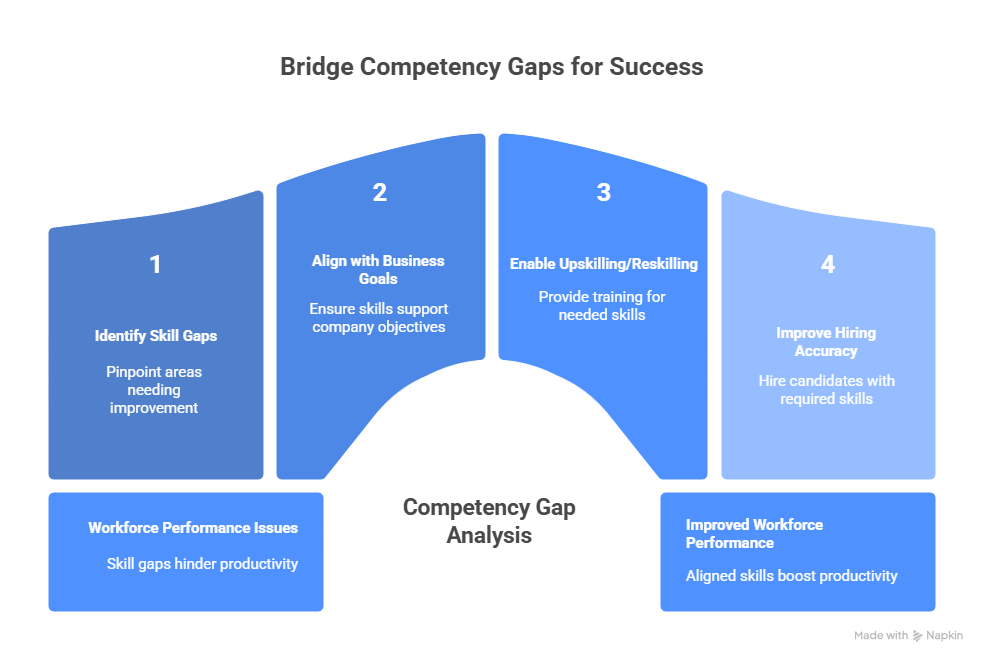
It also strengthens performance management. Managers can use competency gap insights to provide meaningful feedback, create personalized development plans, coach employees more effectively, and support career advancement. Furthermore, competency analysis supports succession planning by identifying high-potential talent and preparing them for leadership roles through targeted development.
Finally, competency gap analysis creates a culture of continuous improvement. Employees gain a clearer understanding of expectations and development opportunities. Organizations, in turn, build a more resilient and future-ready workforce capable of navigating complexity, innovation, and change.
Understanding Organizational Goals
Understanding organizational goals is the foundation of an effective skills gap analysis. Before identifying or addressing any skill gaps, HR professionals and business leaders must have a clear grasp of the company’s mission, vision, and strategic objectives. This clarity ensures that the skills gap analysis is not just a generic exercise, but one that is tightly aligned with the business strategy and the specific skills required to achieve organizational goals.
By mapping out future demands and the competencies required to meet them, organizations can focus their efforts on the necessary skills that will drive growth and innovation. This approach allows HR professionals to prioritize which skill gaps to address first, ensuring that workforce development initiatives directly support the company’s long-term objectives. Ultimately, aligning skills gap analysis with organizational goals helps businesses remain competitive in a rapidly changing market, ensuring that employees are equipped with the specific skills and competencies needed for both current and future success.
Competency Gaps Examples
Competency gaps examples differ widely across industries and job levels, yet they often share common themes. Understanding these examples helps organizations recognize competency challenges more efficiently. Competency gaps typically occur in both hard skills, specific, teachable abilities like analytics or digital communication, and soft skills, such as communication, teamwork, and critical thinking.
The most common competency gaps arise from technical skill shortages. For example, a data analyst may struggle with advanced statistical modeling or machine learning frameworks, limiting their ability to support data-driven decision-making. Similarly, a software engineer may lack experience with cloud computing, DevOps pipelines, or automated testing, resulting in inefficiencies in the development lifecycle.
Another category includes leadership competency gaps. Newly promoted managers often lack critical competencies such as delegation, conflict resolution, emotional intelligence, strategic thinking, or team motivation. These gaps can disrupt team harmony and affect organizational performance. Without leadership training, employees may be technically capable but fail to lead effectively.
Communication competency gaps frequently impact employee performance. Employees may have difficulty presenting ideas clearly, writing reports, managing customer conversations, or collaborating across teams. Communication gaps can lead to misunderstandings, delays, and reduced productivity.
Digital competency gaps are increasingly common across industries that are transitioning toward automation and digital workflows. Employees may struggle with new software, analytics tools, or digital collaboration platforms. Digital illiteracy creates bottlenecks, slows adoption of new technology, and reduces overall productivity.
Behavioral competency gaps also play a significant role. Employees may lack adaptability, resilience, teamwork, accountability, or critical thinking. These soft skills gaps affect attitude, workplace behavior, and the ability to navigate pressure or change.
Compliance and regulatory competency gaps are common in industries such as healthcare, finance, and manufacturing. Employees who are not updated on policies, safety protocols, or regulatory expectations may unwittingly create compliance risks.
Analytical competency gaps manifest when employees struggle to analyze data, identify trends, interpret reports, or solve complex problems. This limits the organization’s ability to innovate or make informed decisions.
These competency gaps examples demonstrate that competency analysis must go beyond identifying skill shortages. It must assess deeper behavioral and cognitive competencies that influence performance quality, including both hard skills and soft skills.
Competency Gap Analysis Framework
A well-defined competency gap analysis framework provides the structure needed to identify, measure, and prioritize competency gaps across the organization. A comprehensive framework ensures that competency evaluation remains consistent, scalable, and aligned with strategic goals.
The first component of a competency gap analysis framework is competency definition. Organizations must identify specific competencies required for each role, department, or function. These competencies include technical knowledge, cognitive abilities, behavioral traits, leadership attributes, and digital literacy requirements. Each competency is assigned a target proficiency level to set performance expectations, and establishing desired skill levels serves as clear benchmarks for evaluating employee performance.
The second component involves competency assessment. This includes using skill gap assessment tools, psychometric tests, performance reviews, interviews, job simulations, and manager evaluations to measure current employee competencies. Assessments must be objective and standardized to ensure fairness. It is essential to evaluate the workforce’s current capabilities to accurately identify where gaps exist relative to desired skill levels.
The next component is gap measurement. This step involves comparing actual competencies with required competencies to identify gaps. Organizations categorize gaps into levels such as critical, moderate, or minor based on their impact on performance.
The fourth component involves prioritization. Not all competency gaps require immediate attention. Organizations must prioritize gaps that impact business objectives, customer outcomes, safety, compliance, or innovation.
The fifth component is development planning. This includes selecting the right interventions such as training, coaching, mentoring, job rotation, certifications, or digital learning modules. Development plans must be personalized to address individual or team-level competency gaps effectively. Leveraging a learning management system can help deliver and track training interventions, ensuring that progress is monitored and aligned with organizational goals. Establishing a learning management system (LMS) can help organizations manage, track, and deliver employee training content effectively.
The final component is monitoring and evaluation. Organizations must track competency improvements over time through follow-up assessments, performance reviews, and feedback loops. This ensures that development plans are achieving the intended results and allows for adjustments as needed.
Together, these framework components create a continuous cycle of competency evaluation, improvement, and strategic workforce planning.
How to Conduct a Competency Gap Analysis
Conducting a competency gap analysis requires thoughtful planning and a structured multi-step process. To ensure comprehensive and accurate evaluation, organizations must follow these detailed steps.
The first step is identifying organizational goals. Competency expectations must align with strategic objectives such as digital transformation, market expansion, process optimization, or innovation. Understanding long-term goals helps determine which competencies are essential and where new capabilities may be needed.
The second step involves defining competency models. For each role, organizations should outline required competencies along with behavioral indicators and proficiency levels. Competency models should reflect both current job expectations and future skills that employees will need as the organization evolves.
The third step is assessing current competencies. Organizations can use digital skill gap assessment tools, technical tests, psychometric evaluations, self-assessments, peer reviews, and performance data to measure an employee’s current level of competency. In addition, focus groups can be conducted with existing employees to gather in-depth feedback and insights into workplace challenges and skill deficiencies. Assessments must be thorough, unbiased, and role-specific. Methods to assess current employee skills include performance reviews, interviews, surveys, and 360-degree feedback.
The fourth step involves analyzing competency gaps. This requires identifying gaps between required proficiency levels and current performance. Organizations should categorize gaps based on severity, business impact, and urgency. For example, competency gaps related to compliance or safety require immediate action, whereas gaps in innovation skills may require long-term talent development plans.
The fifth step is prioritizing development initiatives. Once gaps are identified, organizations must determine which gaps to address first. Priority is typically given to competencies that impact customer experience, performance quality, operational efficiency, or risk management. Creating a detailed plan to address identified skill gaps should include specific actions, timelines, and responsible parties.
The sixth step involves designing targeted development plans. These plans may include instructor-led training, e-learning modules, leadership coaching, mentorship programs, job rotation opportunities, knowledge transfer sessions, or blended learning solutions. Development plans must be tailored to individual needs to ensure maximum impact, with a focus on initiatives that develop employee competencies among existing employees.
The final step is evaluating progress. Organizations must track improvements through reassessment, performance metrics, behavior observations, and continuous feedback. Competency gap analysis must be revisited regularly because workforce needs evolve with business strategy, market conditions, and technological changes.
Competency gap analysis is not a one-time project but an ongoing process that builds a high-performing, adaptable, and future-ready workforce. Integrating competency gap analysis with broader talent management strategies ensures alignment with succession planning, workforce development, and organizational growth.
Competency Gap Analysis Template
A competency gap analysis template provides a structured format for documenting required competencies, mapping proficiency levels, analyzing gaps, and planning development initiatives. A well-designed template includes role-specific competencies, required proficiency scores, actual performance data, gap severity ratings, root cause insights, learning recommendations, and follow-up metrics. Standardizing evaluation through templates improves consistency across teams and speeds up analysis competency initiatives.
How to Identify Competency Gaps
Identifying competency gaps requires comprehensive analysis competency methods, including assessments, interviews, performance metrics, behavior observation, and feedback mechanisms. Organizations must evaluate both quantitative and qualitative aspects of performance to identify competency gaps accurately. Identifying competency gaps early allows targeted interventions that prevent performance decline or project disruption. HR teams often use competency mapping, skill assessments, employee surveys, and AI-based analysis tools to uncover hidden competency gaps at individual and organizational levels.
Competency Mapping Skill Gap Analysis
Competency mapping skill gap analysis helps organizations visualize competency strengths and weaknesses across the workforce. By mapping skills against role requirements, HR teams gain clarity on capability distribution, high-potential talent, and areas requiring training investment. This mapping ensures workforce planning is aligned with organizational strategy.
Skills Gap Analysis Assessment Tools
Digital skill gap assessment tools help automate competency analysis and enable scalable competency evaluation across large teams. These tools use assessments, simulations, analytics, and reporting features to provide detailed insights into competency gaps. They reduce bias, speed up analysis, and offer accurate data for training programs and development planning.
Developing Targeted Training Programs
Once skill gaps have been identified, developing targeted training programs becomes essential for closing those gaps and building a high-performing workforce. Targeted training programs are designed to address specific skill deficiencies, ensuring that employees gain the critical skills required for their roles and for the organization’s continued success.
These programs can take many forms, including on-the-job training, mentoring, coaching, and formal training courses. By focusing on the specific skills and knowledge employees need, organizations can deliver more effective training that leads to measurable improvements in performance. Investing in targeted training programs not only helps address identified skill gaps but also boosts employee engagement and retention, as employees feel supported in their professional development. Ultimately, well-designed training programs ensure that the workforce is equipped with the skills required to meet both current business needs and future challenges.
Implementing Training and Development
Implementing training and development initiatives is a critical step in addressing competency gaps and enhancing workforce capabilities. This process involves delivering training programs that are tailored to the specific skill deficiencies identified during the skills gap analysis. Organizations can leverage a variety of methods, such as online courses, workshops, and on-the-job training, to provide employees with the training resources they need.
It’s important that these training and development efforts are closely aligned with organizational goals and objectives, ensuring that they contribute directly to closing skill gaps and improving overall performance. By providing employees with opportunities to develop new competencies, organizations can strengthen their workforce, close skill gaps, and achieve their strategic objectives. Effective implementation of training and development not only addresses current competency gaps but also prepares employees to meet future organizational demands.
Monitoring and Evaluating Progress
Monitoring and evaluating progress is a vital component of the skills gap analysis process. After implementing training programs, organizations must track how effectively these initiatives are closing skill gaps and improving employee skill levels. This involves regularly assessing workforce capabilities, gathering feedback from employees and managers, and analyzing performance data to identify areas where further improvement is needed.
HR professionals play a key role in this ongoing evaluation, ensuring that training programs remain relevant and that the workforce remains adaptable to changing business needs. By continuously monitoring progress, organizations can make data-driven adjustments to their training strategies, ensuring that their skills gap analysis efforts are delivering the desired impact on organizational performance. This commitment to ongoing evaluation helps companies stay agile, competitive, and ready to meet future challenges.
Benefits of Competency Gap Analysis for Training Programs
Competency gap analysis delivers numerous organizational benefits that influence workforce performance, strategic readiness, and long-term business success.
One of the primary benefits is improved performance. When employees understand their competency gaps, they can work toward meaningful skill development that enhances productivity and output quality. Organizations also gain a clearer understanding of what employees need to succeed, leading to more effective support systems and coaching frameworks.
It also improves training effectiveness. Instead of relying on generic training programs, competency gap analysis allows organizations to tailor learning initiatives to specific needs. This increases training ROI and ensures employees gain skills that directly affect job performance.
Competency gap analysis supports better decision-making in recruitment and internal mobility. HR teams can identify candidates who possess the ideal competency mix for specific roles and ensure new hires align with both job expectations and organizational culture. Internal candidates can be matched with roles based on competency data, ensuring promotions and role transitions are merit-based and strategic.
It enhances succession planning by identifying high-potential employees who demonstrate leadership readiness. Organizations can develop future leaders through targeted programs, ensuring long-term stability and growth.
Competency gap analysis also contributes to employee engagement and retention. Employees who receive personalized development plans and growth opportunities feel valued, supported, and motivated. This contributes to higher retention, reduced turnover costs, and a more committed workforce.
Finally, competency gap analysis strengthens organizational agility. In fast-changing industries, having a workforce that can adapt, learn, and evolve is essential. Competency analysis ensures companies remain competitive by continuously upgrading employee capabilities and addressing emerging skill needs. This helps build a future-ready workforce that can respond effectively to technological advancements, market dynamics, and customer expectations.
According to the World Economic Forum, organizations that proactively address skill gaps and workforce development trends are better positioned to navigate skills disruption and future-proof their business.
Best Practices for Competency Gap Analysis
Adopting best practices for competency gap analysis ensures that organizations can effectively identify, analyze, and address skill gaps within their workforce. A structured approach begins with the use of a competency framework to clearly define the required skills for each role. Regular skills assessments help organizations stay aware of evolving skill gaps and workforce needs.
Providing targeted training programs and development opportunities is essential for closing identified gaps and supporting continuous employee growth. Involving employees in the skills gap analysis process fosters engagement and ownership of professional development. Leveraging data and analytics enables HR professionals to make informed decisions and prioritize training investments that align with organizational goals.
Finally, continuous monitoring and evaluation of progress ensures that competency gap analysis remains an ongoing, dynamic process. By following these best practices, organizations can build a skilled, adaptable workforce that is aligned with business strategy and prepared to achieve long-term success.
How Skillrobo Simplifies Competency Gap Analysis
Skillrobo offers end-to-end competency assessment solutions that help organizations identify competency gaps with precision. Through customizable assessments, validated psychometric tools, role-based competency models, and advanced analytics, Skillrobo provides real-time insights that support competency development. Skillrobo’s platform allows organizations to conduct scalable, objective, and unbiased competency analysis that aligns with business needs and workforce strategy.
Wrapping Up
Competency gap analysis is a powerful tool that enables organizations to build skilled, adaptable, and future-ready workforces. By identifying gaps between required competencies and actual capabilities, companies can design targeted development plans, make strategic talent decisions, improve performance, and enhance employee engagement. As businesses continue to evolve, competency gap analysis becomes essential for organizational success. With tools like Skillrobo, companies can streamline competency evaluation, eliminate guesswork, and build stronger, more capable teams that drive long-term growth.
FAQs
1. What is competency gap analysis?
Competency gap analysis is a structured evaluation process that identifies the difference between required competencies for a role and the current competencies employees possess, enabling targeted development and performance improvement.
2. What is competency gap meaning?
Competency gap meaning refers to the measurable difference between expected job competencies and an employee’s actual performance capabilities, including skills, behaviors, and knowledge.
3. What are competency gaps examples?
Examples include gaps in leadership skills, communication, digital literacy, technical proficiency, compliance knowledge, analytical thinking, and customer service competencies.
4. How do you conduct a competency gap analysis?
Identify role competencies, assess employee capabilities, compare expected and actual proficiency levels, analyze gaps, prioritize development needs, create training plans, and monitor progress over time.
5. What tools help with competency gap analysis?
Skill gap assessment tools, online competency evaluation platforms, skill mapping tools, psychometric assessments, and competency gap analysis templates help organizations identify and address competency gaps efficiently.