Performance Management – Definition, Importance, Framework, and Examples

Key Takeaways
- A performance management system provides multifold benefits – including competitive edge, better employee engagement, and improved work culture.
- Effective performance management involves continuous evaluation of employee performance.
- This process is an ongoing exercise where managers and employees communicate regularly for assessing and reviewing job responsibilities.
- Important decisions pertaining to career development, employee promotions, compensation and benefits, are all linked to managing employee performance.
- Talent assessment tools can be used in performance management to evaluate skill and competencies gaps.
What is Performance Management?
Performance management refers to the ongoing process involving managers and employees for assessment and review of job responsibilities, expectations, performance, and career development strategies. Each role requires a unique set of skills and competencies. Managing employee performance can be made more effective through employee skills assessment. Moreover, the main objective of this process is to empower employees to perform at optimal levels, and align their efforts with the strategic objectives of the organization.
Performance management in HRM helps managers and employees agree on goals and expectations, so that their efforts are aligned with organizational goals. Organizations that operate with a structured framework are not only able to achieve their goals, but are also empower employees to fulfil their work objectives. This blog decodes performance management meaning, and delves into nuances of HR performance management. You will also understand the performance management cycle in detail and get introduced to performance management system examples at the end of this blog.
Why is Performance Management Important?
An effective performance system, while requiring time to plan and deploy, can save you and the employee time and energy. Most importantly, this system can be a very strong motivator for employees to achieve individual success, and for employers to achieve organizational success.
Increased workforce productivity, lower employee attrition, higher employee engagement, and many more benefits can be achieved by implementing a process for managing employee performance.
Performance management is a holistic approach that ensures that individuals and teams within the organization are working towards common organizational goals.
HR performance management involves continuous assessment, development, and improvement of employee performance. This is achieved by implementing a set of activities like goal setting, developmental planning, and performance evaluation. Furthermore skills gap analysis when used as a part of performance evaluation helps identify skill and competency gaps in the workforce.
Future proofing of workforce skills and competencies
The process establishes an unbroken communication chain between managers and employees. It also empowers employees with tools to monitor and improve their skills, learning, and training developments. This cycle provides a structured and organized approach to managing performance. A solid strategy enables employees to understand their roles and responsibilities within the broader organizational context.

Improving employee engagement
A well designed framework for managing employee performance brings transparency into the setting of employee expectations. This framework in HRM provides employees with learning and development opportunities that helps them carve out a clear career path and gain deeper understanding of how their role impacts organizational goals. A talent development program keeps employees aligned with organizational goals, which makes them feel more valued and engaged.
Better employee retention
The transparency that this brings within an organization, enables employees to clearly visualize their progression at work and understand where their career is headed. Furthermore the guidelines laid out by the management system also helps employees understand what they need to reach higher levels in their career. Employees that go through this cycle, are more engaged and are more likely to stay with the organization.
Fosters a culture of feedback and trust
A system for managing employee performance helps establish a culture of communication, trust, and transparency that begins with leadership and HR initiatives. The nature of the process and transparency of employee management policies play an important role in establishing a culture of feedback and trust within the organization. Moreover, when employees receive honest and constructive feedback on their work from their managers, it builds mutual trust and fosters open mindedness at the workplace.
Improves organizational performance
When employee performance is managed efficiently, it automatically translates to overall improvement in organizational performance. Improved organizational performance in turn translates to customer satisfaction and high productivity. When employees learn, develop, and perform better in their respective roles, it has a cascading effect on the wider business.
What is Performance Management in HR?
Performance management in HR is a strategic and systematic way of establishing a continuous conversation between employees, managers, and HR to drive both individual and organizational success. This management framework includes verbal and written components that are exercised throughout the year. This process culminates in the year end performance appraisal process.
The goals of this process is to develop skills and competencies required to improve performance on the job. Performance goals include performance expectation setting. When performance expectations are set right, employees gain clarity over what is expected of them and what they can gain by meeting these expectations. This system provides continuous, real-time feedback that helps employees understand where they stand, areas of improvement, and identify growth opportunities. Enterprise performance management also allows employees to see how their individual goals align with the organizational goals. Also understand how their contributions impact organizational growth.
Key Components
This is an annually recurring phenomenon that entails continuous, year-round evaluation of employees. The goal of this cycle is to develop and execute employee performance goals. All the employees in the organization go through this cycle, which starts with goal setting and ends with developing improvement plans. This process carried out in 4 stages. Here is a look at the 4 stages in the process –
Goal planning – The goal planning stage focuses on setting performance expectations for employees. A simple equation that guides goal planning is given below. To perform well, employees need to clearly know what is expected out of them. The starting point in setting expectations is to have an updated job description. It is a best practice to actively involve the employee in this planning process, which increases satisfaction with the performance cycle. Employee performance plans need to be flexible, so that they can be modified according to changing objectives.
Performance Monitoring – In the second phase, the goals that are set in the planning phase are tracked actively. Monitoring of employee performance involves continuous measurement of performance and providing feedback on progress towards the goals. Effective monitoring of employee performance when dealing with educated professionals needs to focus on whether the goal is achieved, rather than how it is achieved.
Development – Development post performance monitoring plays a key role in improving employee performance. Actively monitoring performance enables employees to identify areas where they can improve their performance. Performance feedback may reveal underperformance that needs to be corrected or superior performance which the employee wants to excel further. Performance improvement can be achieved via training and development and also by taking up challenging assignments and opportunities for personal and professional growth.
Rating and Rewards – Determining the performance rating is usually done during the annual performance appraisal. In cases where the employee’s performance has been performing at below sub-par level continuously, the employment is considered for termination. In case the employee maintains a superior performance track record, the employee is recognized for his performance with appropriate rewards or a promotion, or both.
What are Various Methods in Performance Monitoring?
Performance management in HRM includes various approaches to tracking and managing performance, each one with unique characteristics. Organizations can choose the method for managing employee performance as per their requirements.
Goal-based Approach – The goal-oriented approach focuses on setting Specific Measurable Achievable Relevant Time-bound goals for employees. This is the most popular approach that gives employees clarity, purpose, and motivation. SMART goals help employees prioritize tasks and motivate them to achieve them. Types of SMART goals include performance, development, and stretch goals.
Continuous performance management – This method is a holistic approach to managing employee performance, where managers and employees discuss work performance and goals on a continuous basis. In the continuous performance method, managers provide constructive, real-time performance feedback to their team members, which is combined with goal-setting and check-ins.
Continuous management of performance provides feedback more frequently, which helps employees and managers build a stronger foundation of trust and authenticity. Feedback also helps in addressing issues quickly before they escalate.
Management by objectives – Management by objectives (MBO) is a highly useful management method that helps analyze the overall performance of an employee in their role. By following the MBO approach, managers assess the job requirements of a role and verify if they align with organizational objectives. The next step is to collect and analyze employee performance data to see how they align with organizational objectives.
360 Degree Feedback – 360 degree feedback is a method where an employee receives feedback from their managers, peers, and self-evaluation. This approach provides employees with a broad overview of their performance, as opposed to a single view from their manager. A large part of the ownership of 360 degree feedback lies on the employee, while managers are concerned with overseeing reports to note and address key concerns. Feedback can also be used to inform employee training and development plans.
Performance appraisals – This type of assessment is among traditional methods, that happens on an annual, biannual, or quarterly basis. Performance appraisal discussions are carried out on a one-on-one basis between the employee and their manager. Managers prepare thoughtful feedback in relation to employees’ performance, for identifying their strengths, weaknesses, and key improvement areas. These appraisals are helpful tools that provide employees with a clear picture of their career path, and steps required to get promoted.
Coaching – Coaching is a performance management process that is aimed at mentoring and developing skills of employees and their knowledge. Coaching is carried out via one-to-one conversations. This method focuses on specific skills or goals, coaching sessions are non-directive.
In this method, employees are not given specific solutions, rather encouraged to find solutions for themselves. Coaching is a skilled activity which lays the imperative on managers to have the required training and skills for coaching employees.
The examples discussed above cover a wide range of applications. You can choose the one that closely aligns with your organizational culture.
Who Uses Performance Management Software?
Businesses have been managing the performance of their employees for many decades using traditional methods that follow paper-based or email-based approaches. Interestingly, one of the first formal systems for managing employee performance was introduced during the First World War by the military to understand the strengths and capabilities of each member to inform battle strategies. From these types of systems to the modern software that works on cloud technology and artificial intelligence – performance management has evolved by leaps and bounds.
Practically, any company with an employee base can use a performance management software. Regardless of the size and type of the company, there are tangible benefits that performance management software brings to the table. Although every employee interacts with the system at some stage with performance management software, the manager or team leader with direct reports drives the software. Here is how performance management software is used by employees, HR professionals, and managers.
Employees use performance management systems in conjunction with their managers to define their performance goals. They can build their individual employee performance reviews within the system, and take part in 360 degree review cycles if this model is used.
HR professionals can use software for managing employee performance to define HR systems and processes that drive the management cycle. They work with managers and employees to ensure that implementation of the performance management system is carried out properly in a timely fashion.
Managers are the ones that use these systems extensively. They are the power users of the system and have the responsibility of ensuring that every employee actively participates in the process.
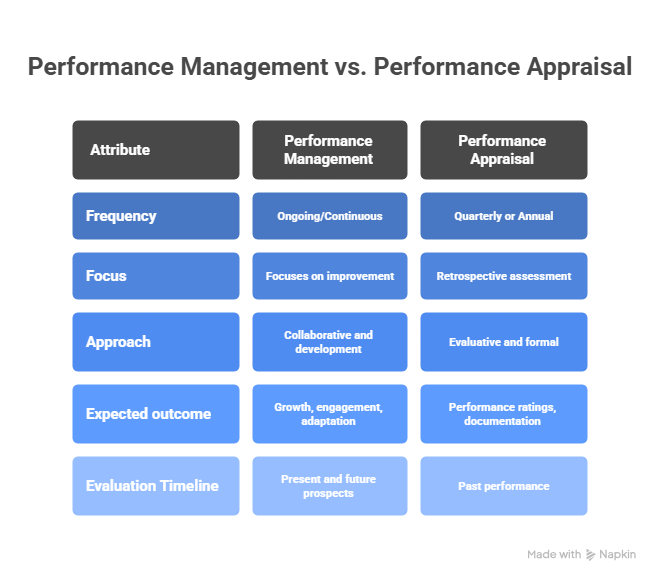
Are Performance Management and Performance Appraisal the Same?
You can think of performance management as the whole journey, while performance appraisal is one stop on the road. Let us look at the key differences and similarities between the two terms.
What are Performance Management Best Practices?
Best practices in focus on streamlining the performance management process. Consistency and transparency are key to optimizing the process. The performance management cycle is an ongoing process that needs to be streamlined for maximum efficiency.
Here are some of the best practices that you can review before implementing a performance management system in your organization-
Provide Ongoing, Interactive Feedback – To derive best results from managing employee performance you need to ensure that the feedback is provided throughout the year. Gathering feedback on performance just before the performance appraisal is not effective and is not an accurate representation of the employee’s skills and capabilities. When employee performance data is collated throughout the year, it is holistic and meaningful.
Evaluate what currently is working – Before modifying the software or tools, it is important to evaluate the current system. Understanding what is working and what is not provides the HR team a holistic idea of the system. To evaluate the effectiveness of the current system, HR teams must survey both employees and managers to gather opinions on the current performance management system. These internal findings must be combined with evidence-based research on new performance management systems. Key decision makers must be provided with such comprehensive data in order that they make informed decisions on implementing the new system.
Choose the right approach to performance management – There are 2 types of performance management approaches that organizations can choose from. One is the behavioral approach that focuses on identifying and evaluating employees based on their behavior and effort at the workplace. This approach provides useful information on workplace behavior, which the HR can use in performance management. The second approach is the result-oriented approach that evaluates employees objectively on the results they deliver. This approach focuses on output in terms of quality and quantity.
Train managers adequately – In order that the performance management process is successful, managers must be familiar with the usage of the performance management software/tool. Only when they are aware and are trained on the software, will they be able to use the software effectively. HR needs to plan to train managers well so that they receive constructive feedback.
Set SMART goals – It is important to set SMART goals around employee performance management. Managers and employees must set these goals and involve HR while setting goals for employee development. Employees must have their own clear, personalized set of key performance indicators (KPIs) so that they understand expectations from their roles, and their managers can track their performance scores.
Set up a Formal System – Continuous management of performance boosts employee engagement, motivation, and performance. Effective performance management can be achieved only when you have a formal performance or appraisal system in place. Further, having a formal system sends out a message to all employees that great work will get due recognition.
Employ Technology – Leveraging HR technology and software helps improve efficiency and effectiveness of the process. Using the right technology saves managers a lot of time and also streamlines the performance management process.
Examples of Performance Management Systems
Performance management examples include all the different methods used for managing employee performance. The examples discussed below can be used as a guide by managers to define their own system for managing performance.
HSBC
HSBC uses a mobile HR app that can be used by managers and employees to capture achievements and share performance feedback. HR to-do list, performance and development plans, online learning sessions, and personal employment information can be accessed via this app.
Netflix
Netflix uses continuous performance management that replaces annual reviews with frequent real-time feedback, coaching, and check-ins.
Google uses OKRs for clear goal setting and tracking across teams.
How Skillrobo Streamlines Employee Talent Assessment?
Assessment of skill and competency gaps is an integral part of performance management. Once the skill gaps are identified, it becomes easy to identify areas of improvement that will enhance the performance of employees. Talent assessments in Skillrobo enable managers to assess the current skills and competencies within their team. The reports and analytics provided by Skillrobo provide a snapshot of the skill gaps. Managers and HR can conduct talent development and training sessions to bridge these gaps, which in turn improves employee performance.
The AI-powered test generator in Skillrobo can create custom tests for employee talent assessment within minutes. Skillrobo plays an important role in strategy and workforce planning by enabling accurate competency gap analysis.
What are the Upcoming Trends in Performance Management?
The performance management process has evolved into a technology driven HR function. Keeping up with the latest trends in managing employee performance helps HR managers upgrade their workforce development strategy. Here are the upcoming trends that need your attention-
Shift to Continuous Performance Management
Slowly, but surely global organizations are shifting from traditional systems to a continuous performance management model. This model does not take the formal approach that archaic methods take towards employees and managers. Implementing this management model involves higher rates of engagement between employees and managers.
Dynamic teams
Modern systems for managing employee performance must be flexible to adjust to evolving business needs. Dynamic teams require a shift from traditional systems to agile systems.
Wrapping Up
We have covered performance management in detail, including what is performance management process, why is performance management important, and the best practices in managing employee performance. Effective management of employee performance extends beyond annual reviews, it is a continuous improvement process that aligns employee goals with organizational goals. Drive organizational success with strategies to manage employee performance. Build a culture of continuous growth by evaluating employee skills and competencies regularly and identifying skill gaps in the workforce. Use Skillrobo to assess employee skills and competencies. Sign up for the demo today.
FAQs
1. What Is Performance Management?
Performance management is a structured approach organizations use to set expectations, monitor progress, provide feedback, and evaluate employee performance over time. It focuses on aligning individual contributions with organizational goals while supporting continuous improvement and professional growth.
2. Why Is Performance Management Important for Organizations?
Performance management helps organizations improve productivity, ensure accountability, and maintain alignment between business objectives and employee efforts. It also enables managers to identify performance gaps early, recognize high performers, and support employees through targeted development initiatives.
3. How Often Should Performance Management Activities Be Conducted?
It is most effective when management of performance is carried out on an ongoing basis, rather than limited to annual reviews. Many organizations adopt continuous performance management practices that include regular check-ins, goal reviews, and feedback sessions throughout the year.
4. What Are the Key Elements of an Effective Performance Management Process?
An effective process for managing employee performance includes clear goal setting, measurable performance indicators, consistent feedback, fair evaluations, and development planning. When these elements work together, employees gain clarity on expectations and opportunities for improvement.
5. How Does Performance Management Support Employee Development?
Performance management supports employee development by identifying strengths, skill gaps, and areas for improvement through structured evaluations and feedback. This information helps organizations design relevant training programs, coaching initiatives, and career development plans.