Hiring Bias – Types of Hiring Biases and How to Reduce Them
TL;DR
- Skill-based assessments help reduce hiring bias by focusing on actual capabilities rather than personal background or subjective impressions.
- Structured assessment methods promote consistency across all candidates, ensuring fair and equal evaluation.
- Objective evaluations strengthen trust in the hiring process and enhance candidate experience.
- Incorporating unbiased assessments into recruitment leads to better hiring decisions and a more diverse workforce.
- Reducing bias in hiring contributes to long-term improvements in team performance, culture, and retention.
Types of Hiring Bias
Affinity Bias or Similarity Bias – Occurs when hiring teams favor candidates with similar background
Confirmation Bias – Occurs when recruitment teams seek information to confirm the initial positive or negative impression of a candidate
Gender/Racial Bias – Occurs when one gender or race is favored over another, arising from deep rooted stereotypes
Halo/Horn Effect – Occurs when one strong positive or negative trait overshadows all others
Age Bias – Occurs when hiring teams show preference for or against older or younger candidates over their skills and capabilities
What is Hiring Bias?
Hiring bias, often unconscious, continues to challenge fair decision-making in recruitment. Even well-intentioned hiring managers can lean on familiarity or assumptions, influencing who gets hired and who gets overlooked. Over time, this weakens diversity, limits innovation, and reduces access to qualified talent.
Structured assessments offer a practical solution. By shifting the focus from personal impressions to job-relevant skills, these tools create a more consistent and fair hiring process.
A study by Harvard Business Review revealed that 76% of HR professionals admit bias impacts hiring, especially when relying on resumes or unstructured interviews. To build more inclusive teams, organizations must move beyond intuition and use tools that measure what truly matters, skills, potential, and performance.
In this blog, we explore how structured assessments reduce hiring bias, how HR teams can implement them effectively, and how tools like Skillrobo support equitable hiring practices.
Understanding Bias in Hiring
Bias in hiring shows up in subtle ways, such as assumptions based on a candidate’s name, education, background, or even how well they “fit” into an existing team culture. These tendencies, though unintentional, result in homogeneous workplaces and missed opportunities.
Even experienced recruiters are susceptible to these biases, especially under time pressure or without structured hiring practices in place. Over time, unchecked bias can create systemic patterns that disproportionately affect underrepresented groups.
Unconscious bias leads hiring managers to favor candidates similar to themselves, often without realizing it. Affinity bias, halo effect, and confirmation bias all distort how candidates are perceived, leading to evaluations based on familiarity instead of merit.
These biases can manifest in ways as small as assuming someone is more competent because they share a background or interest with the interviewer. Learn more about how unfair hiring practices affect recruitment and organizational growth.
Types of Hiring Bias
Hiring bias refers to unconscious or conscious patterns of judgment that influence recruitment decisions in ways unrelated to a candidate’s actual ability to perform the job. These biases often emerge subtly, shaped by human psychology, workplace norms, and past experiences. Understanding the different types of hiring bias is essential for organizations that aim to build fair, high-performing, and diverse teams.
Affinity Bias in Hiring Decisions
Affinity bias occurs when recruiters or interviewers favor candidates who resemble them in background, interests, education, or personality. This may show up as a preference for candidates from the same university, similar career paths, or shared hobbies. While familiarity feels comfortable, it often leads to homogenous teams and limits access to diverse perspectives that drive innovation and balanced decision-making.
Confirmation Bias During Candidate Evaluation
Confirmation bias influences hiring when decision-makers form an early opinion about a candidate and then selectively interpret information to support that belief. For example, an interviewer who assumes a candidate is strong based on a prestigious employer may overlook weak answers, while another candidate may be judged more harshly for minor gaps. This bias narrows objectivity and reduces the reliability of interviews.
Halo and Horn Effect in Interviews
The halo effect occurs when one positive trait, such as confidence or strong communication, creates an overall favorable impression, masking potential shortcomings. Conversely, the horn effect allows a single negative aspect, like nervousness or a resume gap, to overshadow a candidate’s strengths. Both distort balanced assessment and shift focus away from role-specific competencies.
Gender Bias in Recruitment Practices
Gender bias surfaces when assumptions are made about a candidate’s capabilities, availability, or leadership potential based on gender. This may include underestimating technical skills, questioning long-term commitment, or associating leadership qualities with stereotypical traits. Such bias not only impacts fairness but also restricts access to top talent.
Cultural and Name Bias
Candidates may be unconsciously judged based on their names, accents, or cultural backgrounds. This bias can influence resume screening and interviews, even when qualifications are identical. Cultural bias limits inclusivity and prevents organizations from benefiting from globally diverse skill sets and experiences.
Age Bias Across Career Stages
Age bias affects both younger and older candidates. Early-career professionals may be perceived as inexperienced, while seasoned candidates may be viewed as resistant to change or overqualified. These assumptions ignore individual capability and adaptability, leading to missed opportunities across generations.
Similarity Bias in Team Fit Assessment
When hiring managers overemphasize “culture fit,” similarity bias often follows. Candidates who align closely with existing team norms are favored, even if diversity of thought would strengthen outcomes. This bias reinforces existing dynamics rather than evolving them to meet future business needs.
Effects of Hiring Bias at the Workplace
Hiring bias does not stop at flawed recruitment decisions; its consequences ripple across teams, culture, and long-term business performance. When bias shapes who gets hired, promoted, or rejected, organizations often experience hidden costs that are difficult to reverse later.
Reduced Quality of Hires
When decisions are driven by bias rather than capability, organizations risk overlooking highly qualified candidates. Roles may be filled by individuals who fit subjective preferences instead of job requirements, leading to performance gaps, extended ramp-up time, and repeated rehiring cycles.
Lack of Workforce Diversity
Hiring bias directly limits diversity across gender, age, culture, and thought. Homogeneous teams may feel comfortable initially but often struggle with creativity, adaptability, and problem-solving. Over time, this lack of diversity weakens innovation and reduces an organization’s ability to serve diverse markets.
Lower Employee Engagement and Morale
Employees quickly recognize unfair patterns in hiring and promotion. When teams perceive favoritism or exclusion, trust in leadership declines. High performers may disengage when effort and skill are not the primary drivers of opportunity, resulting in lower motivation and productivity.
Increased Attrition and Talent Loss
Bias-driven hiring and advancement decisions often push skilled employees to leave. Individuals who feel undervalued or unfairly assessed are more likely to seek inclusive workplaces elsewhere. This leads to higher turnover costs and loss of institutional knowledge.
Weakened Employer Brand
Organizations known for biased hiring practices struggle to attract top talent. Negative candidate experiences spread quickly through professional networks and employer review platforms, damaging reputation and reducing the quality of future applicant pools.
Legal and Compliance Risks
Unchecked hiring bias increases exposure to discrimination claims and regulatory scrutiny. Even unintentional bias can result in legal consequences, financial penalties, and reputational harm that extends beyond recruitment.
Poor Leadership Pipelines
Bias in hiring often carries into promotions, resulting in leadership teams that lack diverse perspectives. This weakens strategic decision-making and limits an organization’s ability to navigate complex business challenges.
Long-Term Cultural Impact
Over time, hiring bias shapes organizational culture. Teams become less open, less collaborative, and more risk-averse. Psychological safety declines as employees feel pressure to conform rather than contribute authentically.
By understanding the effects of hiring bias, organizations can recognize why fair, structured, and skill-based hiring practices are not just ethical choices but strategic necessities for sustainable growth.
Impact on Diversity
Bias narrows the talent pool and hinders progress on diversity and inclusion goals. Teams lacking diverse perspectives often struggle with innovation and adaptability. Organizations that fail to address bias risk missing out on candidates who bring fresh ideas, global perspectives, and broader problem-solving approaches. Promoting diversity requires actively dismantling biased systems and building hiring processes rooted in fairness and objectivity.
Subjective Pitfalls
Relying heavily on resumes or casual interviews allows bias to creep in. These methods focus more on presentation than proven skills and performance. Resumes may highlight polished language or prestigious affiliations, but rarely offer a true measure of day-to-day competencies. Similarly, informal interviews often reward charisma over capability, leading to hires who may not be the best fit for the role’s actual demands.
Assessments counteract these issues by offering a structured way to evaluate candidates based on competency gaps, not assumptions. By shifting the focus to evidence-based testing and role-relevant criteria, organizations can level the playing field and make more inclusive, data-driven hiring decisions.
How Assessments Counter Hiring Bias
Skill assessments create a level playing field by evaluating every applicant on the same criteria. Instead of guessing who might be the best fit, hiring teams can use performance data to make decisions that are fair and aligned with job requirements. This structured approach removes ambiguity and helps organizations shift from assumption-based hiring to evidence-driven evaluation.
Objective Skill Focus
Assessments evaluate candidates on measurable skills such as analytical thinking, communication, or problem-solving. This reduces the influence of subjective impressions and keeps decisions focused on what candidates can do. Unlike resumes or interviews, skill tests provide a quantifiable snapshot of job readiness.
Standardized Process
Every candidate completes the same test under the same conditions, removing variability from the evaluation process and reinforcing fairness. Standardization ensures consistency across departments and locations, allowing HR teams to compare candidates on equal terms. This is particularly helpful in high-volume or multi-location hiring.
Blind Evaluations
Removing names or demographic details during scoring ensures hiring decisions are based solely on performance and potential. Blind testing removes cues that might trigger unconscious bias, such as names, gender, or educational background. It encourages an impartial view of candidates and supports truly inclusive hiring.
Job-Relevant Criteria
Assessments can be customized to match the exact requirements of the role. This ensures that candidates are judged on skills that truly impact success in the position, such as software proficiency, decision-making ability, or customer interaction style. Explore more about competency assessment tools that support role-specific evaluation and help tailor tests to organizational needs.
Benefits of Bias-Reduced Hiring
Reducing bias through structured assessments leads to better-quality hires, stronger teams, and more inclusive work environments. This approach ensures that hiring decisions are guided by skill and performance, not assumptions or familiarity. Over time, it fosters a more equitable company culture and supports long-term organizational success.
Enhanced Diversity
Skill-based evaluations open opportunities for candidates from all backgrounds by focusing on what they can do, not where they come from. This levels the playing field for underrepresented groups who may not have access to traditional credentials but possess the right capabilities. A diverse team also brings broader perspectives, improving problem-solving and innovation.
Improved Job Fit
When hiring decisions are based on objective data, candidates are better matched to the role, leading to higher productivity and engagement. Assessments help ensure alignment between individual strengths and role requirements, reducing the risk of misplacement. The result is a workforce that performs more efficiently and adapts quickly to evolving needs.
Stronger Employer Brand
Fair and transparent hiring practices build trust among candidates and help attract top-tier talent. Organizations that prioritize equitable recruitment processes are seen as more progressive, inclusive, and employee-centric. Learn more about the value of skill-based assessments in improving hiring outcomes and shaping a positive employer reputation.
Reduced Turnover
When the right people are hired for the right roles, retention improves. Employees are more likely to thrive and stay when hired based on merit. They feel valued for their contributions, which increases engagement, loyalty, and long-term commitment to the organization.
Strategies to Reduce Bias with Assessments
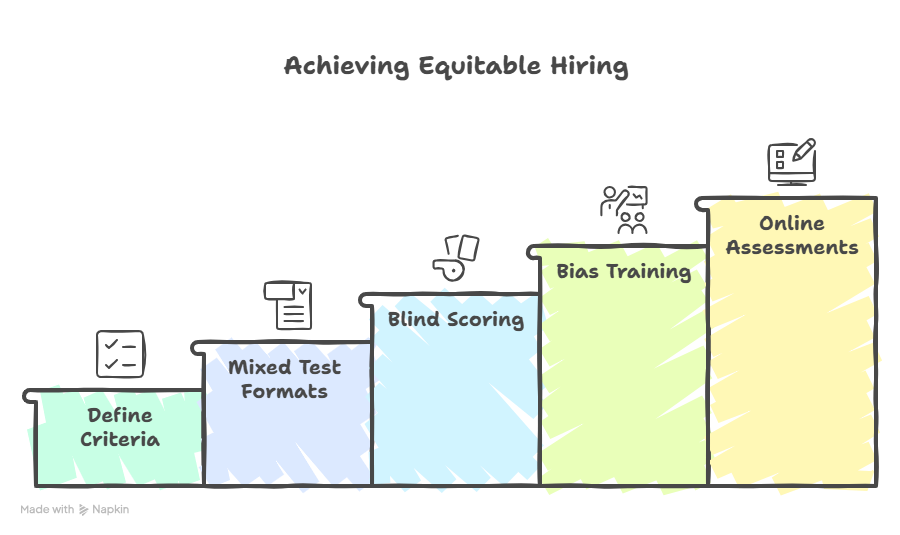
To fully benefit from assessments in hiring, HR teams must thoughtfully design and apply them. A well-implemented assessment process can significantly reduce bias, while a poorly planned one can create new inconsistencies. It’s not just about using assessments, it’s about building a system that is fair, relevant, and aligned with organizational values.
Define Clear Criteria
Set specific benchmarks for the role, whether technical, cognitive, or behavioral, and design assessments that reflect those expectations. Avoid vague descriptors like “leadership qualities” unless clearly defined through observable traits or skills. This helps create a transparent standard that all candidates are measured against equally.
Use Mixed Test Formats
Incorporate a combination of skills-based, situational, and behavioral assessment methods to get a well-rounded view of each candidate’s potential. Each test type offers unique insights, technical tests gauge functional capability, while behavioral assessments evaluate interpersonal and emotional intelligence. A mix also prevents over-reliance on one dimension of a candidate’s profile.
Implement Blind Scoring
Removing identifying details during the scoring process prevents any bias from influencing the final outcome. Names, photos, age, or educational institutions can all unintentionally affect judgment. Blind scoring ensures that decisions are based strictly on performance and capability, not background details.
Train Hiring Teams
HR teams and hiring managers should be educated on bias awareness and how to interpret assessment results fairly and accurately. Regular training workshops can help teams identify their blind spots and reinforce consistent evaluation practices. When everyone involved understands the purpose and mechanics of the assessments, the process becomes more trustworthy and inclusive.
How Skillrobo Supports Fair Hiring
Skillrobo helps organizations implement structured, bias-reducing assessments at scale. Its platform allows HR teams to create role-specific assessments tailored to technical, cognitive, or behavioral requirements.
Skillrobo supports unbiased hiring by shifting focus from subjective impressions to structured, skill-based evaluation. Standardized assessments measure role-relevant competencies, cognitive ability, and behavioral traits using consistent criteria for all candidates. This approach minimizes the influence of personal preferences, surface-level impressions, and unconscious assumptions. By grounding hiring decisions in data and job relevance, Skillrobo enables organizations to build fairer, more objective, and performance-driven recruitment processes.
With features like anonymized scoring, real-time analytics, and flexible assessment formats, Skillrobo supports consistent, data-driven hiring decisions. This ensures every candidate is evaluated fairly, on their skills, not their background.
Conclusion
Bias in hiring can limit access to top talent and prevent organizations from building truly diverse, high-performing teams. Assessments offer a clear, structured way to reduce this bias, replacing assumptions with measurable data.
By focusing on skills, potential, and role-specific capabilities, hiring becomes more equitable and aligned with business goals. Tools like Skillrobo help streamline this process, enabling companies to make smarter, fairer hiring decisions at scale.
Ready to transform your hiring process with structured assessments?
Sign up for Skillrobo and build a more inclusive, skill-first workforce.
FAQs
What causes hiring bias in recruitment processes?
Hiring bias is often driven by unconscious assumptions, personal experiences, cultural norms, and time pressure during decision-making. Recruiters may rely on mental shortcuts that feel efficient but lead to subjective and unfair evaluations.
How can hiring bias affect business performance?
Hiring bias reduces access to skilled talent, weakens team diversity, and increases turnover. Over time, this impacts productivity, innovation, and the ability to build strong leadership pipelines.
Is unconscious bias more common than intentional bias in hiring?
Yes. Most hiring bias is unconscious. Decision-makers are often unaware of how their preferences or assumptions influence screening, interviewing, and final hiring decisions.
Can structured assessments help reduce hiring bias?
Structured, role-based assessments create consistent evaluation criteria for all candidates. This reduces reliance on intuition and personal judgment, making hiring decisions more objective and fair.
What is the first step organizations should take to address hiring bias?
The first step is awareness. Training hiring teams to recognize bias, combined with standardized hiring processes and data-driven assessment tools, helps organizations make more equitable hiring decisions.