What is Aptitude Assessment and Its Importance in Hiring
I have seen organizations spend weeks trying to find the right fit for open job positions. Sometimes even weeks of hiring effort fail to find the right candidate.
Hiring teams realize that candidates hired based on technical skill evaluation alone do not fit into the team and are misaligned with the company’s culture.
If your goal is to hire the best fit (both technical and soft skills), then you need to include aptitude assessments in pre-employment assessments.
Aptitude assessments are effective in evaluating working potential of prospective hires. I have seen an upward shift in the quality of hiring once I included these assessments in the pre-employment screening process.
What is an Aptitude Assessment Test?
Aptitude assessment tests are designed to assess the capabilities of individuals. These tests can also predict what a person is able to learn or do with the right education and training. The most pressing challenge that HR teams face is hiring the right person for the right job. Although hiring may seem like a straightforward HR task, there are several challenges in finding the right fit for a role.
Recruiters cannot get the complete picture of the candidate’s aptitude and capabilities from the resumes or interviews alone. While resumes and interviews provide valuable insights, they often fail to reveal how effectively a candidate can think, adapt, and perform under pressure. This is where aptitude assessment tests come into play.
In this blog we will delve deeper into aptitude assessment tests, the need for pre-employment aptitude tests, types of aptitude assessments, how aptitude tests help in hiring the right candidates, and what skills do aptitude assessment tests measure.
How Job Aptitude Tests Outperform Traditional Screening
Traditional hiring methods often place a heavy weight on resumes, academic credentials, and subjective interviewer impressions. However, these inputs don’t always reflect a candidate’s ability to adapt, problem-solve, or handle the cognitive demands of a specific role. In contrast, job assessment tests offer far more actionable insights:
1. Direct measures of learning potential and cognitive flexibility
Aptitude tests evaluate how quickly candidates process new information, apply reasoning, and solve unfamiliar problems, critical indicators for success in fast-changing business environments.
2. Predictive indicators of long-term job success
Rather than focusing solely on experience, aptitude scores help forecast how candidates will perform and develop over time, improving both initial job fit and future growth potential.
3. Fairer evaluations across diverse candidate backgrounds
By standardizing assessment conditions, aptitude tests reduce bias linked to education pedigree, personal networks, or demographic factors, giving all candidates an equal platform to demonstrate ability.
4. Improved early-stage filtering, reducing unqualified candidates early
Recruiters can efficiently screen out candidates who lack core reasoning capabilities before investing further time in interviews or technical assessments.
5. Higher correlation with on-the-job performance
Multiple studies confirm that aptitude test results often correlate more strongly with job performance than resumes, interviews, or reference checks, particularly for roles requiring critical thinking and learning agility.
By incorporating pre-employment aptitude test solutions into their hiring funnel, recruiters significantly improve both hiring quality and operational efficiency, ensuring that only the strongest candidates move forward.
How Does an Aptitude Assessment Test Work?
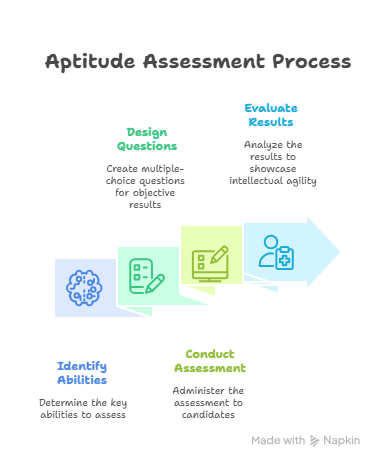
What is an aptitude assessment test and how does it work? An aptitude test is not about what a person already knows, it’s about how they think. It measures potential rather than knowledge. By focusing on abilities such as logical reasoning, problem-solving, and decision-making, aptitude tests give employers a deeper understanding of a candidate’s strengths and weaknesses.
In recruitment, aptitude assessment tests serve as predictive tools that determine how well a candidate can learn new skills, respond to challenges, and contribute to business success. For job seekers, these tests are an opportunity to showcase their intellectual agility and learning potential beyond academic qualifications. Furthermore, as organizations continue to evolve toward skills-based hiring, aptitude assessments have become an integral part of modern workforce evaluation.
At their core, aptitude tests assess cognitive potential. They examine how quickly and accurately a person can analyze information, draw conclusions, and respond to challenges. Common areas evaluated through aptitude tests include numerical reasoning, verbal ability, logical reasoning, abstract thinking, and problem-solving skills. Some tests also measure attention to detail and the ability to work with data or symbols, depending on job requirements.
In recruitment and pre employment screening, aptitude tests help employers identify candidates who can learn quickly, adapt to new situations, and handle role-specific challenges effectively. This is particularly important for entry-level positions, graduate hiring, and roles where on-the-job learning plays a major role. By focusing on potential rather than experience, aptitude tests create a more level playing field for candidates from diverse educational and professional backgrounds.
Aptitude tests are also widely used beyond hiring. Organizations rely on them for internal assessments, training needs analysis, and career development planning. Educational institutions use aptitude tests to guide students toward suitable career paths, while employers use them to identify high-potential talent and plan succession strategies.
When implemented thoughtfully, aptitude tests add objectivity and consistency to decision-making. They reduce bias, support data-driven evaluations, and help organizations make more confident choices about hiring, training, and workforce development.
An aptitude assessment test is a standardized evaluation designed to measure how well an individual can perform certain cognitive or reasoning-based tasks. It provides a snapshot of a candidate’s intellectual abilities, such as comprehension, analysis, interpretation, and decision-making.
Typically, these tests include multiple-choice questions that cover areas like logical reasoning, numerical ability, and verbal understanding. The candidate’s score is then benchmarked against job-specific criteria or industry standards to determine suitability for a role.
Also, aptitude assessments are widely used in recruitment because they offer objective results that are difficult to manipulate. Unlike interviews, which can be influenced by presentation skills or bias, aptitude tests assess actual capability under timed, standardized conditions.
For instance, an organization hiring for a financial analyst role might use a numerical reasoning test to measure data interpretation skills, while a customer service position might focus on verbal reasoning to evaluate communication ability. By using such targeted tests, companies ensure that hiring decisions are based on measurable competencies rather than assumptions.
Why Should Recruiters Use Aptitude Tests
For recruiters and HR teams, aptitude tests serve several critical functions that improve both immediate hiring decisions and long-term workforce planning. By providing objective, measurable insights into a candidate’s problem-solving and learning ability, these assessments strengthen every stage of the talent lifecycle.
1. Objective Screening
Standardized scoring ensures every applicant is assessed fairly and consistently, eliminating the variability of subjective evaluations and ensuring that all candidates compete on an equal footing.
2. Early Shortlisting
High-scoring candidates can be automatically advanced to subsequent stages of the hiring process. This helps recruiters focus their attention on the most qualified individuals, accelerating time-to-hire and reducing manual screening efforts.
3. Bias Reduction
Structured testing minimizes unconscious bias by focusing purely on cognitive capability rather than factors like educational background, demographics, or resume formatting, which often introduce unintended bias into hiring.
4. Talent Mobility
Aptitude test results not only support external hiring but also provide valuable data for internal career progression and talent mobility. Scores inform cross-functional role alignment, allowing companies to move existing employees into new roles that match their cognitive strengths and growth potential.
5. Talent Development Assessment
Cognitive profiles generated from aptitude testing serve as a foundation for ongoing talent development assessment. These insights help identify skill gaps, inform personalized training plans, and prepare employees for leadership, succession, and reskilling initiatives.
By leveraging aptitude test software, recruiters can administer assessments at scale and integrate candidate results directly with employee evaluation software. This ensures hiring decisions are supported by a centralized, data-driven system that aligns recruitment, development, and workforce planning seamlessly.
Types of Aptitude Assessment Tests Used by Employers
Employers use a range of aptitude tests depending on job roles, industry requirements, and the skills they aim to evaluate. Each test targets specific areas of intelligence and problem-solving.
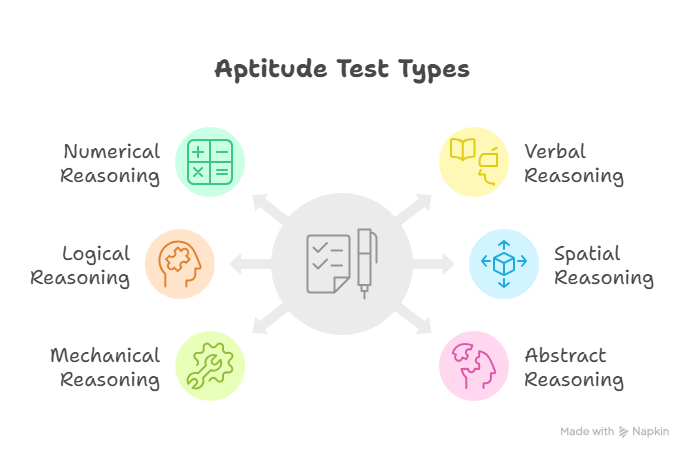
Numerical Reasoning Tests
These tests measure the ability to interpret data, perform calculations, and draw conclusions from numerical information. Candidates might be asked to analyze graphs, charts, or tables to solve problems. Such tests are common in roles related to finance, data analysis, and engineering.
Verbal Reasoning Tests
Verbal reasoning assessments evaluate how well candidates understand and analyze written information. They test comprehension, grammar, vocabulary, and logical reasoning through short passages and related questions. They are especially important for roles in communication, marketing, law, and management.
Logical Reasoning Tests
Logical reasoning tests assess critical thinking and the ability to identify patterns, relationships, and logical connections between data points. Candidates may need to solve puzzles or deduce outcomes based on given conditions. This test type is often used for management, IT, and strategic roles.
Spatial Reasoning Tests
These tests measure visual thinking and spatial awareness, the ability to visualize and manipulate shapes, patterns, or objects in space. They are widely used in design, architecture, and mechanical engineering fields.
Mechanical Reasoning Tests
Mechanical reasoning assessments test understanding of physical principles like motion, force, and energy. Candidates might need to interpret diagrams or explain mechanical processes, making this test valuable for technical, manufacturing, and engineering positions.
Abstract Reasoning Tests
Abstract reasoning evaluates creative problem-solving and pattern recognition without relying on language or numbers. It measures how quickly a candidate can identify trends and relationships between abstract shapes or figures. This test is useful for identifying innovative thinkers capable of learning new concepts.
Together, these test types give recruiters a multidimensional understanding of a candidate’s aptitude, ensuring a comprehensive assessment process.
Aptitude Test Questions Examples Recruiters Can Use
Designing effective aptitude tests means selecting job-relevant questions that assess real-world reasoning capabilities. Below are aptitude test questions across core assessment categories that recruiters can leverage to evaluate candidates for diverse roles.
1. Numerical Reasoning
This section evaluates a candidate’s ability to analyze data, interpret numbers, and solve quantitative problems, which are critical for finance, analytics, operations, and technical roles.
- A company earns $500,000 per quarter. What’s its annual revenue?
Answer: $2,000,000 - If 8 workers complete a project in 10 days, how many days for 4 workers?
Answer: 20 days - A product priced at $250 is discounted by 20%. What is the sale price?
Answer: $200 - A stock price increases by 15% from $40. What’s the new price?
Answer: $46
2. Verbal Reasoning
Assesses language comprehension, grammar, vocabulary, and written logic. Essential for client-facing roles, policy interpretation, leadership, and written communication-heavy positions.
- Choose the synonym for “Ambiguous”:
A) Clear
B) Uncertain
C) Easy
D) Specific
Answer: B) Uncertain - Select the correctly spelled word:
Occurrence / Ocurrence / Occurence
Answer: Occurrence - Fill in the blank:
Despite the delay, the team remained _____ in their efforts.
A) negligent
B) persistent
C) careless
D) indifferent
Answer: B) persistent - Choose the antonym for “Scarce”:
A) Abundant
B) Few
C) Limited
D) Rare
Answer: A) Abundant
3. Logical Reasoning
Tests pattern recognition, deductive reasoning, and problem-solving agility. Often used for IT, analytics, operations, and management roles.
- What comes next: 5, 10, 20, 40, ___
Answer: 80 - Find the odd one out: Apple, Orange, Carrot, Banana
Answer: Carrot - Which figure completes the pattern? (Visual question – typically involving shapes or sequences)
Answer: Dependent on the diagram (pattern-based solution) - Series: 2, 6, 12, 20, ___
A) 28
B) 30
C) 32
D) 34
Answer: A) 30
4. Situational Judgment
Presents realistic work scenarios to evaluate interpersonal skills, decision-making, and emotional intelligence. Common for leadership, customer service, and people management roles.
- A colleague misses multiple deadlines. What is your first action?
Answer: Speak privately to address underlying issues and solutions. - A customer requests a service outside the policy. Your response?
Answer: Explain policy respectfully while offering alternatives. - Two team members argue during a meeting. What do you do?
Answer: Mediate calmly, clarify facts, and realign focus on objectives. - A new team member struggles with a task. Your next step?
Answer: Offer support, clarify instructions, and schedule follow-up training.
Industry-Specific Use Cases for Recruiters
While aptitude testing follows universal cognitive principles, its true power lies in how assessments are customized for different industries. Recruiters across sectors can design job aptitude tests that reflect the real-world reasoning, problem-solving, and decision-making demands specific to each role. By aligning test content with job functions, recruiters improve predictive accuracy and ensure candidates possess the core capabilities required for success.
1. Finance & Banking
Numerical reasoning tests are essential for roles in investment analysis, risk management, forecasting, and financial reporting. Candidates must demonstrate strong quantitative aptitude to handle data-driven decision-making under pressure.
2. Technology
Logical reasoning assessments evaluate how software developers, systems architects, and IT analysts approach complex problem-solving. Strong pattern recognition and cognitive agility directly correlate with technical troubleshooting and innovation.
3. Healthcare Administration
Verbal reasoning tests help assess candidates for roles requiring policy interpretation, documentation accuracy, and compliance adherence, critical for healthcare operations, billing, insurance, and medical administration roles.
4. Customer Service & Sales
Situational judgment tests measure candidates’ empathy, conflict resolution, communication skills, and decision-making abilities. High scorers demonstrate stronger client engagement, problem-solving, and customer satisfaction capabilities.
5. Engineering & Manufacturing
Spatial reasoning assessments allow recruiters to evaluate candidates’ ability to mentally visualize components, read technical drawings, and troubleshoot process flows. This is vital for mechanical design, CAD roles, production planning, and quality control.
Aptitude Tests versus Skill Tests
| Criteria | When to Use Aptitude Tests | When to Use Skill Tests |
|---|---|---|
| Primary Purpose | Measure cognitive ability, reasoning skills, and learning potential. | Measure job specific knowledge and practical expertise. |
| Best For | Roles where long term growth and adaptability matter more than immediate specialization. | Roles that require immediate execution and hands on performance. |
| Entry Level Hiring | Ideal for graduates and freshers who may lack experience but demonstrate strong analytical ability and learning agility. | Less suitable unless the role requires specific technical knowledge from the beginning. |
| Leadership Pipeline | Useful for identifying candidates with decision making capability and strategic thinking potential. | Limited relevance unless leadership roles demand specialized technical expertise. |
| High Volume Hiring | Effective for screening large applicant pools quickly and objectively. | Can be used after shortlisting but may not be efficient as an initial filter. |
| Industries Undergoing Transformation | Valuable when adaptability, cognitive flexibility, and learning speed are critical. | Useful if transformation requires specific technical skill sets immediately. |
| Technical Hiring | Not sufficient alone for highly specialized roles. | Essential for roles such as software engineers, data analysts, compliance officers, and finance professionals. |
| Deadline Driven Projects | Helpful for assessing long term potential but not ideal when immediate contribution is required. | Critical when new hires must contribute immediately without extended training. |
| Remote Hiring | Supports objective evaluation of cognitive ability. | Provides direct validation of capability without in person assessment. |
| Onboarding Risk Reduction | Identifies candidates who can learn and grow into the role. | Ensures new hires can perform required tasks with minimal supervision or training. |
Benefits of Using Aptitude Assessment in Recruitment
The use of aptitude assessments offers numerous benefits for both employers and candidates. For employers, these tests bring scientific precision to the recruitment process. They identify candidates who can thrive in complex environments, ensuring that hiring decisions are backed by data and analysis rather than intuition.
A major benefit of aptitude testing is objectivity. Since all candidates are evaluated using the same criteria, the results are fair, unbiased, and easily comparable. This enhances the credibility of the hiring process and supports compliance with equal opportunity standards.
Additionally, aptitude tests are predictive of long-term job performance. Research consistently shows that employees who perform well on these assessments tend to excel in their roles and demonstrate higher productivity. This helps organizations reduce training costs and improve employee retention.
For candidates, these tests offer a transparent way to demonstrate their true potential, especially for those with unconventional backgrounds or limited experience. The tests highlight intellectual agility, allowing capable individuals to stand out based on merit.
How Skillrobo Simplifies Aptitude Testing for Recruiters
Skillrobo provides recruiters with an advanced AI-powered, no-code platform that transforms how aptitude testing is managed. Unlike rigid, one-size-fits-all solutions, Skillrobo enables organizations to design fully customized online aptitude test workflows tailored to their exact hiring needs. Whether screening for cognitive ability, problem-solving, or domain-specific reasoning, recruiters can create tests that directly reflect real-world job demands. This flexibility ensures assessments remain relevant, predictive, and aligned with business objectives across every department.
- Role-specific test libraries aligned with job competencies.
- Adaptive question delivery for personalized assessments.
- Seamless integration with ATS, HRIS, and employee assessment software.
- Secure data handling with full GDPR and EEOC compliance.
- Predictive analytics that inform data-driven hiring and internal mobility decisions.
With Skillrobo, HR teams not only streamline external hiring pipelines but also strengthen internal talent mobility, ensuring high-potential employees are identified, developed, and advanced. Its intuitive design, robust analytics, and seamless integrations allow recruiters to build scalable, efficient, and transparent assessment processes, all while enhancing candidate experience and long-term organizational alignment.
Final Takeways
The job aptitude test provides recruiters with the objective data needed to improve hiring accuracy, reduce bias, and strengthen workforce agility. By combining aptitude assessments with pre-employment tests, AI talent assessment, and integrated employee assessment software, organizations make smarter, faster, and more inclusive hiring decisions.
Sign up for Skillrobo today to elevate your hiring strategy with powerful aptitude testing solutions built for modern recruiters.
FAQs
1. What Are Aptitude Assessment Tests?
Aptitude assessment tests are structured evaluations designed to measure a candidate’s cognitive abilities, including logical reasoning, numerical ability, verbal comprehension, and problem-solving skills. They help employers assess a person’s potential to learn, adapt, and perform in a specific role rather than measuring existing technical knowledge.
2. Why Do Employers Use Aptitude Assessment Tests?
Employers use aptitude assessment tests to make objective and data-driven hiring decisions. These tests reduce bias, improve hiring accuracy, and identify candidates with strong learning agility and analytical thinking. They are especially useful in entry-level hiring and high-volume recruitment.
3. What Is the Difference Between Aptitude Tests and Skill Tests?
Aptitude tests measure cognitive potential and reasoning ability, while skill tests evaluate job-specific knowledge and technical competence. Aptitude tests predict future performance and learning capacity, whereas skill tests confirm current expertise.
4. Are Aptitude Assessment Tests Difficult?
The difficulty level depends on the role and the type of assessment. Most aptitude tests are designed to evaluate reasoning patterns rather than memorized knowledge. With practice and familiarity with question formats, candidates can improve their performance significantly.
5. How Can Candidates Prepare for Aptitude Assessment Tests?
Candidates can prepare by practicing sample questions in logical reasoning, numerical analysis, verbal ability, and abstract thinking. Timed mock tests help improve speed and accuracy. Understanding common question patterns and strengthening foundational reasoning skills also improves results.