Learning Agility: Definition, Importance, and Best Practices
Key Takeaways
- Learning agility is a critical predictor of future leadership potential, shaping how individuals navigate ambiguity, solve complex challenges, and guide teams effectively.
- Defining learning agility clearly allows organizations to assess whether employees can adapt, learn quickly, and apply insights across new and unfamiliar contexts.
- Learning agility assessments provide actionable insights into leadership readiness, innovation capacity, and long-term talent potential.
- Real-world learning agility examples illustrate how agile leaders behave during uncertainty, respond to change, and inspire teams to learn continuously.
- Organizations can strengthen leadership pipelines by integrating learning agility exercises, assessments, and structured development plans into their talent strategy.
Introduction
Leadership in modern organizations is no longer defined by authority, tenure, or industry expertise. It is defined by adaptability. As industries transform rapidly, leaders must absorb new information quickly, navigate evolving challenges, and make decisions without having all the answers. This is where learning agility becomes indispensable. It is the ability to learn, unlearn, and relearn at speed, enabling leaders to respond fluidly to uncertainty and guide their teams toward clarity. Unlike learning ability, which is more innate or IQ-based, learning agility is behavioral and can be developed through experience and training.
Learning agility meaning extends beyond technical competence or knowledge accumulation. It reflects a leader’s ability to embrace new perspectives, question long-held assumptions, and adjust behavior in response to changing conditions. True learning agility involves both the willingness and ability to learn from experience and apply that learning to new situations. Leaders with high learning agility are naturally curious, emotionally intelligent, and resilient in the face of disruption. They consistently seek growth, welcome feedback, and find opportunities in unfamiliar situations. This mindset allows them to thrive where others hesitate.
Organizations increasingly recognize that learning agility is a more accurate indicator of future leadership success than past performance. Experience alone does not prepare leaders for unprecedented change, technological disruption, or global uncertainty. Instead, leadership potential rests in how well individuals learn from experience and transfer those lessons effectively to new challenges. As a result, learning agility assessment tools have become essential components of leadership development, hiring, and succession planning.
This comprehensive blog explores the meaning of learning agility, its significance in developing strong leaders, real-world examples, assessment strategies, exercises to strengthen agility, and how companies like Skillrobo support agility-based leadership evaluation.
What Is Learning Agility?
Learning agility is the ability to learn from experience, adapt quickly to new situations, and apply those insights to future challenges. An agile learner is someone who is adaptable, open to new ideas, and thrives in uncertain environments. It reflects how leaders think, behave, and evolve when navigating unfamiliar territory. Those with high learning agility demonstrate a willingness to experiment, a hunger for new knowledge, and the confidence to pivot when circumstances demand it.
A crucial part of the learning agility definition is the emphasis on applying learning, not merely acquiring it. Agile leaders do not rely solely on what they already know. They remain open to change, actively seek new inputs, and adjust decisions based on emerging trends or feedback. Key behaviors that demonstrate learning agility include openness, resilience, adaptability, and a proactive approach to new challenges. Learning agility meaning therefore incorporates intellectual flexibility, emotional resilience, and behavioral adaptability.
Learning agility also reflects how leaders relate to others. They must interpret situations accurately, understand diverse viewpoints, and foster trust even during periods of uncertainty. Feedback seeking is another key behavior that reflects learning agility, as it shows a willingness to learn from others and improve performance in dynamic environments. In a world where collaboration is critical, the interpersonal dimensions of agility become as important as cognitive agility.
Ultimately, learning agility answers a fundamental leadership question: when faced with something new, does the leader become overwhelmed or do they lean into learning and adapt? The answer determines whether someone can grow into a role with increasing responsibility and complexity.
Why Learning Agility Is Critical for Modern Leadership
The importance of learning agility in the workplace has grown dramatically as organizations navigate digital transformation, global volatility, and shifting workforce expectations. Leaders no longer operate within predictable conditions. Their success depends on how quickly they learn, adapt, and guide others through change. Learning agility is especially critical for leaders to effectively navigate change, helping their teams remain resilient and responsive in uncertain times.
One reason learning agility is so essential is the speed at which industries evolve. Technological shifts, competitive disruptions, and regulatory changes require leaders to understand new landscapes quickly. Leaders with high agility do not cling to outdated approaches. Instead, they remain flexible, adjust strategies early, and motivate their teams to embrace change rather than resist it.
Learning agility also enables better problem-solving. In complex environments, leaders must make decisions without complete information. Agile leaders are comfortable analyzing emerging patterns, exploring multiple scenarios, and pivoting swiftly when needed. They engage in strategic experimentation rather than rigid execution.
Leadership agility also strengthens team culture. Employees want leaders who listen, communicate transparently, and understand the emotional impact of change. Leaders with strong people agility connect with diverse personalities, read group dynamics accurately, and adjust communication styles to build trust and psychological safety.
Most importantly, learning agility prepares organizations for the future. As jobs evolve and new competencies emerge, leaders with agility identify skill gaps early, adapt their workforce development plans, and ensure teams remain competitive. In this environment, organizations striving to build an agile learning culture are better equipped to support adaptability and continuous improvement. Companies with high learning agility among leaders and employees often achieve higher profit margins compared to their peers, making learning agility a strategic leadership advantage.
The Core Dimensions of Learning Agility for Leaders
Learning agility is multi-dimensional. Each dimension strengthens leadership performance in different ways and helps organizations evaluate where leaders excel and where they need development. In addition, personality traits such as openness and conscientiousness are often evaluated to understand learning agility, as these traits can indicate an individual’s flexibility and adaptability.
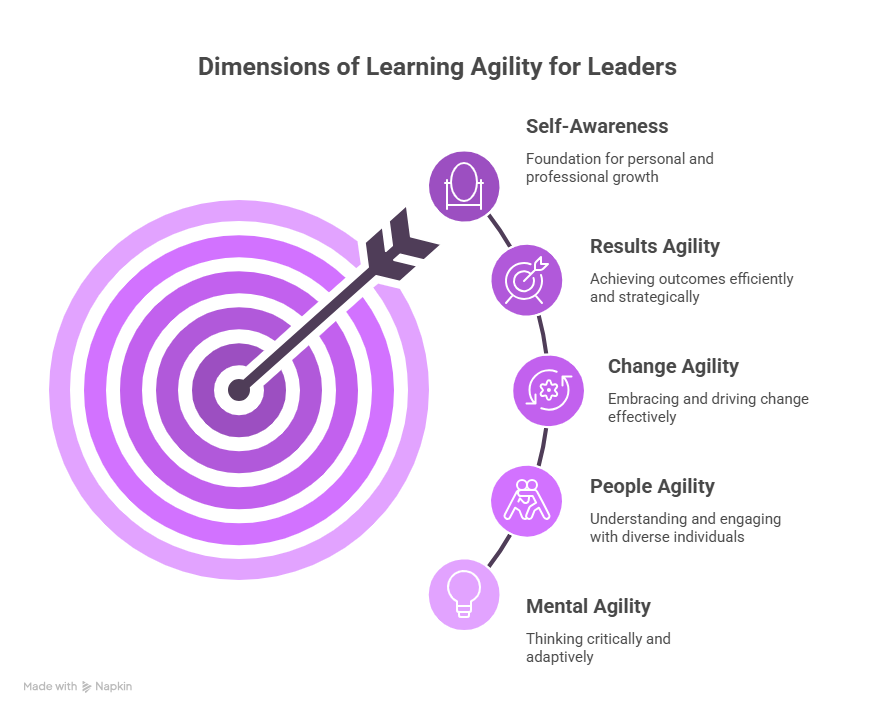
Mental Agility
Mentally agile leaders thrive in complexity. They analyze ambiguous problems, question assumptions, generate new ideas, and synthesize diverse information quickly. By making fresh connections between ideas, they are able to solve complex problems with innovative solutions. They avoid rigid thinking and prefer innovative approaches over conventional solutions. This makes them highly effective in fast-changing industries where strategic thinking is essential.
People Agility
People’s agility reflects emotional intelligence and interpersonal adaptability. Leaders with strong people agility build trust, communicate effectively, and navigate conflict with composure. They value different perspectives, using them to navigate conflicts and cultural differences effectively. They read emotional cues, understand team dynamics, and adapt communication methods to fit individual or group needs. This dimension influences morale, motivation, and collaboration across the team.
Change Agility
Change-agile leaders embrace uncertainty with enthusiasm. They remain optimistic during transitions, initiate improvements proactively, and help others feel comfortable with unfamiliar situations. Their resilience allows them to lead teams through technological adoption, organizational restructuring, or market disruptions. This adaptability is crucial for transformation-driven environments.
Results Agility
Results agility measures a leader’s ability to deliver strong outcomes even in unfamiliar or high-pressure scenarios. Agility individuals are proactive, adaptable professionals who excel in new or unpredictable situations by demonstrating resourcefulness, calmness, and resilience. These leaders stay focused, resourceful, and resilient. They work through obstacles strategically, maintain momentum, and reinforce accountability within their teams. Their confidence and steady performance inspire trust and followership.
Self-Awareness
Self-aware leaders understand their strengths, limitations, emotional patterns, and blind spots. Leaders with high self awareness are more effective and have fewer blind spots, enabling them to make better hiring decisions and lead teams successfully. They actively seek feedback, acknowledge areas for improvement, and adjust behaviors to enhance performance. This humility reinforces authenticity, makes leaders more coachable, and drives continuous growth.
Together, these dimensions create a robust framework for understanding learning agility in leadership and designing development programs that strengthen leadership capability across the organization.
The Importance of Growth Mindset
A growth mindset is the foundation of learning agility, empowering individuals to see every challenge as a chance to grow and develop new skills. Korn Ferry research highlights that a growth mindset is a key component of learning agility, enabling leaders and employees alike to continually develop and adapt in the face of new and challenging situations. When individuals believe their abilities can be improved through effort and learning, they are more likely to embrace continuous learning and seek out opportunities for skill development.
HR professionals play a pivotal role in cultivating a growth mindset across their organizations. By promoting a culture that values learning and resilience, HR can encourage employees to take on new challenges and step outside their comfort zones. This can be achieved through personalized learning paths that align with individual career goals, regular agility assessments to identify strengths and areas for growth, and structured feedback sessions that support ongoing improvement. When employees are supported in this way, they are more willing to tackle challenging situations, continually develop their capabilities, and drive innovation within the organization.
Ultimately, fostering a growth mindset not only enhances individual performance but also strengthens the organization’s ability to adapt to change and implement new business strategies. By embedding growth mindset principles into talent development programs, HR professionals ensure their teams are equipped to thrive in an ever-evolving business landscape.
Stepping Out of the Comfort Zone
True learning agility is developed when individuals are willing to step out of their comfort zones and embrace new experiences. Taking on new challenges and responsibilities is essential for building self-awareness, as well as developing critical thinking and problem-solving skills, qualities that are vital for navigating today’s evolving environments. According to LinkedIn Learning, those who regularly push beyond their comfort zones are better equipped to adapt to change, acquire new skills, and accelerate their career growth.
HR professionals can facilitate this growth by creating opportunities for employees to expand their skill sets and gain fresh perspectives. Initiatives such as cross-functional training, job rotation, and mentorship programs expose employees to different teams, roles, and business strategies, helping them develop a broader understanding of the organization. These experiences not only build confidence but also foster a culture of agile learning, where employees are encouraged to continuously learn and respond quickly to new challenges.
By supporting employees as they step into unfamiliar territory, organizations can nurture learning agile individuals who are ready to solve problems, drive innovation, and lead in dynamic business environments. This proactive approach to talent development ensures that teams remain adaptable, resilient, and prepared for future success.
Overcoming Barriers to Learning
Developing learning agility requires individuals to overcome common barriers that can hinder their ability to continually develop and grow. Korn Ferry research identifies obstacles such as lack of time, limited resources, and low motivation as frequent challenges in the pursuit of continuous learning. Addressing these barriers is essential for building a culture where learning agile employees can thrive.
HR professionals are instrumental in removing these obstacles by providing access to a wide range of learning resources, including online courses, training programs, and on-the-job learning opportunities. Encouraging a continuous learning culture means not only making resources available but also motivating employees to take advantage of them. This can be achieved by integrating learning into performance reviews, recognizing and rewarding skill development, and offering personalized learning paths that align with individual aspirations.
Additionally, fostering a growth mindset helps employees view setbacks as opportunities for improvement rather than roadblocks. Regular feedback and reflection sessions enable employees to assess their progress, identify areas for development, and create actionable strategies to overcome learning barriers. By supporting employees in this way, HR professionals help build a workforce that is resilient, adaptable, and committed to lifelong learning, key attributes for organizational agility and long-term success.
Real Leadership-Oriented Learning Agility Examples
Leadership-based learning agility examples help illustrate how agile leaders behave in real situations. A learning agile person is curious, quick to learn, and thrives in changing environments, embracing new challenges and rapidly acquiring new skills.
An example occurs when a leader must adopt a new digital platform for team operations. Instead of resisting, they learn the system, identify efficiencies, and guide the team through adoption. Their change agility prevents delays and boosts productivity.
Another example involves crisis management. During a sudden shift in market conditions, an agile leader reevaluates priorities, reorganizes workflows, and communicates transparently with the team. Their calm responsiveness helps stabilize morale.
A leadership agility example also appears when a manager receives constructive feedback about their communication style. They adjust their approach, request feedback regularly, and improve working relationships. Their people’s agility improves team cohesion.
Finally, leaders with strong agility take on challenging assignments outside their expertise. They learn quickly, engage stakeholders effectively, and deliver strong outcomes. Such examples demonstrate why learning agility influences leadership success more than experience alone.
How to Assess Learning Agility in Leaders and Employees
Assessing learning agility requires structured, objective methods that analyze how individuals behave in unfamiliar situations. Organizations use multiple tools to evaluate cognitive adaptability, emotional intelligence, resilience, and openness to feedback. Learning agility assessments are commonly used to measure learning agility in both leaders and employees, providing valuable data for talent development.
Psychometric assessments measure traits such as cognitive flexibility, exploratory thinking, and openness to new ideas. These tests provide quantifiable insights into how leaders think and respond to change. Cognitive ability tests are often included as part of the assessment process to evaluate reasoning skills and the capacity for learning and adaptability.
Situational judgment tests place leaders in hypothetical scenarios that mirror real workplace challenges. Their responses reveal problem-solving ability, decision-making patterns, and behavioral adaptability. Behavioral interviews are also used to evaluate a candidate’s ability to adapt, learn, and respond to new or challenging situations.
Peer and 360-degree feedback add critical perspective by capturing how leaders behave in real environments. Feedback from direct reports is a key part of 360-degree assessments, helping to assess collaboration style, emotional responses, and willingness to learn.
Platforms like Skillrobo offer learning agility tests that combine scenarios, behavioral indicators, and cognitive measures. Automated scoring and detailed analytics reveal agility strengths, weaknesses, and leadership readiness.
A combination of these methods ensures an accurate, complete assessment of learning agility across leadership roles.
Learning Agility Exercises for Leaders and Teams
Building learning agility requires consistent practice. Leadership agility exercises help strengthen adaptability, enhance problem-solving, and build resilience across teams.
Reflective learning is a powerful exercise. Leaders analyze decisions and outcomes after major projects or challenges, identifying lessons that guide future behavior. This deepens self-awareness and encourages deliberate adaptation.
Cross-functional collaboration exposes leaders to different work styles, responsibilities, and problem-solving approaches. Engaging with diverse teams strengthens people’s agility and broadens strategic perspective. These exercises also support employee learning and adaptability by encouraging knowledge sharing and skill development across functions.
Simulated scenarios or crisis workshops help leaders practice responding to unexpected shifts. These simulations enhance cognitive flexibility and emotional control under pressure.
Stretch assignments push leaders outside their comfort zone, building resilience and results agility. Leaders gain confidence in navigating unfamiliar challenges.
Feedback loops such as peer coaching or mentoring circles improve self-awareness and communication agility. These exercises create a culture of transparency and continuous improvement, helping leaders and teams to continuously improve through ongoing feedback and development.
Learning sprints allow leaders to acquire new knowledge quickly. Short-term learning cycles stimulate curiosity and help leaders adapt more rapidly to evolving expectations.
Together, these exercises form a structured approach to strengthening learning agility at individual and team levels. They are also used to train leaders to be more agile and adaptive in the face of change.
Why Learning Agility Drives Organizational Excellence
Organizations that prioritize learning agility benefit from stronger innovation, adaptability, and collaboration. Social learning further enhances knowledge retention across teams by encouraging collaboration and resource sharing. Agile leaders drive performance by modeling curiosity, resilience, and open communication. Their teams innovate more, navigate challenges effectively, and embrace continuous improvement.
Learning agility also supports digital transformation by enabling teams to adopt new tools and workflows without resistance. Agile leaders encourage experimentation, reducing fear of failure and helping teams adapt quickly.
From a strategic perspective, learning agility ensures that companies remain competitive. It enables organizations to develop and implement new strategies to address complex problems and adapt to changing market conditions. As markets shift, agile organizations pivot early, recognize emerging opportunities, and evolve faster than competitors.
Ultimately, learning agility enhances organizational resilience. Teams led by agile leaders recover quickly from disruption, collaborate deeply, and sustain productivity during uncertainty.
Learning Agility in Leadership Development and Succession Planning
Learning agility is now a foundational criterion for leadership development and succession planning because it predicts long-term leadership effectiveness more accurately than experience alone. Traditional succession plans based on tenure or technical expertise fail when future challenges require adaptability rather than expertise.
In leadership development programs, learning agility identifies individuals who can handle greater responsibility, absorb feedback, and grow into increasingly complex roles. Agile leaders embrace stretch assignments, collaborate across functions, and experiment with new leadership strategies.
Succession planning relies on learning agility to identify high-potential employees who can lead through uncertainty and innovation. Organizations map agility scores, compare readiness levels, and build personalized development paths that accelerate leadership capability.
Companies often integrate rotation programs, coaching relationships, crisis simulations, and strategic project leadership opportunities into development plans. These experiences strengthen resilience and adaptability, helping emerging leaders gain confidence and agility.
By prioritizing learning agility, organizations ensure a strong leadership pipeline capable of guiding the business through future transformation and disruption.
How Skillrobo Supports Learning Agility Assessment
Skillrobo offers comprehensive learning agility assessment tools that enable organizations to evaluate adaptability, problem-solving, emotional intelligence, and strategic thinking. The platform provides customizable tests, scenario-based evaluations, automated scoring, and analytics dashboards that highlight agility strengths and gaps.
Skillrobo helps organizations identify future leaders, optimize training investments, create targeted development plans, and make evidence-based succession decisions. With scalable technology and real-time reporting, Skillrobo empowers companies to build agile, high-performing teams and accelerate organizational growth.
Wrapping Up
Learning agility is no longer an optional leadership trait. It is essential for navigating the complexities of modern business. Leaders with strong learning agility think independently, collaborate effectively, embrace change with confidence, and inspire teams during unfamiliar challenges. They drive innovation, accelerate transformation, and strengthen organizational resilience.
By adopting learning agility assessment tools, implementing targeted exercises, and integrating agility into leadership development programs, organizations can build strong, future-ready leadership pipelines. Platforms like Skillrobo make this process seamless, data-driven, and scalable. As the workplace continues to evolve, learning agility will remain the foundation of effective leadership and long-term organizational excellence.
FAQs
1. What is learning agility and why is it essential for leaders?
Learning agility is the ability to learn quickly, adapt to unfamiliar situations, and apply insights to new challenges. It is essential for leaders because modern workplaces demand adaptability, strategic thinking, emotional intelligence, and resilience during constant change. Leaders with strong agility guide teams effectively and make informed decisions even in uncertainty.
2. How do organizations assess learning agility?
Organizations assess learning agility using psychometric tests, behavioral interviews, situational judgment assessments, 360-degree feedback, and learning agility test tools like Skillrobo. These methods evaluate adaptability, openness to feedback, decision-making styles, and problem-solving in ambiguous situations.
3. What are some examples of learning agility in leadership?
Examples include leaders who pivot strategies when market conditions change, adopt new technology quickly, seek feedback to improve communication, volunteer for challenging assignments, and guide teams smoothly through uncertainty. These behaviors reflect adaptability, resilience, and proactive learning.
4. How can leaders develop learning agility?
Leaders can develop learning agility through reflective practice, stretch assignments, cross-functional collaboration, crisis simulations, feedback loops, learning sprints, and continuous learning. These activities strengthen agility across mental, interpersonal, and emotional dimensions.
5. Why is learning agility important for succession planning?
Learning agility identifies individuals capable of handling more complex leadership roles. It predicts whether employees can grow, adapt, and lead effectively in the future. Succession plans that prioritize learning agility build stronger leadership pipelines and enhance organizational resilience.