Dark Triad Personality Test – Meaning, Importance, Examples
TL;DR
The dark triad personality test is a psychometric assessment that measures narcissism, Machiavellianism, and psychopathy as behavioral tendencies rather than clinical conditions
These traits often remain hidden in interviews because individuals with dark triad tendencies can appear confident, persuasive, and high-performing
Psychometric testing uncovers consistent thinking patterns related to power, empathy, manipulation, and risk-taking
Dark triad personality test questions are indirect and scenario-based, making them harder to manipulate than traditional evaluations
Online dark triad personality test tools offer surface-level insight, while validated assessments provide reliable and contextual interpretation
Understanding dark triad test results meaning requires role relevance, organizational context, and professional analysis.
High Scores in Dark Triad Personality Test
- Low Agreeableness – Most Consistent Characteristic
- High Extroversion – Narcissists or Psychopaths
- Low Conscientiousness – Psychopaths or Machiavellians
- Cause Conflict in Competitive Environments
What Is Dark Triad Personality Test?
The dark triad personality test is a psychometric assessment designed to evaluate a cluster of socially aversive personality traits that influence how individuals relate to power, control, empathy, and personal gain. Unlike clinical tools that diagnose mental health disorders, this assessment focuses on behavioral tendencies that exist across the general population.
The concept of the dark triad personality originates from personality psychology research that identified recurring patterns among individuals who prioritize self-interest over collective outcomes. These individuals may appear confident, charismatic, and decisive, particularly in competitive or high-pressure environments. While such traits can drive short-term success, they often carry long-term interpersonal and ethical risks.
A dark triad personality test does not categorize individuals as toxic or dangerous. Instead, it measures tendencies along a spectrum, recognizing that most people display these traits to some degree. Psychometric testing provides a structured and objective way to understand these patterns rather than relying on assumptions, stereotypes, or isolated incidents.
In this blog, you will learn what the dark triad personality truly means, how psychometric testing assesses these traits, how to interpret dark triad test results meaningfully, what real-world dark triad examples look like, and why responsible use of these assessments is essential in hiring and leadership contexts.
Understanding the Dark Triad Personality
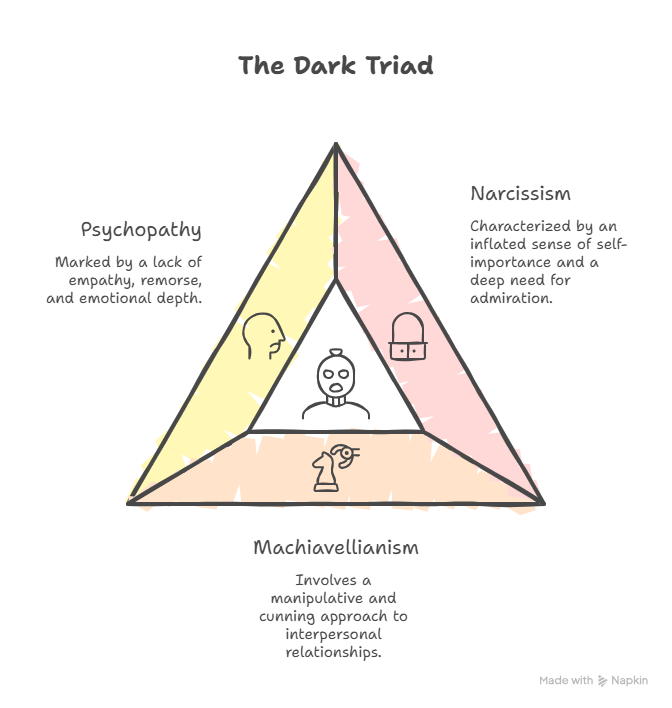
The dark triad personality consists of three interrelated traits that shape interpersonal behavior, decision-making, and leadership style. While each trait is distinct, they often overlap in real-world settings.
Narcissism reflects an inflated self-view, a need for admiration, and sensitivity to criticism. Individuals high in narcissistic traits often seek recognition and validation, positioning themselves at the center of success narratives.
Machiavellianism is defined by strategic manipulation, emotional detachment, and a results-oriented mindset. Those with strong Machiavellian tendencies may be politically skilled and calculating, often viewing relationships as tools for achieving personal goals.
Psychopathy, in non-clinical contexts, refers to impulsivity, fearlessness, and reduced empathy rather than violent behavior. These traits may appear as emotional coldness, risk-taking, and limited remorse when decisions affect others negatively.
Together, these traits form the dark triad personality. Psychometric testing helps distinguish between healthy assertiveness and exploitative behavior by identifying consistent patterns across multiple dimensions.
Why Traditional Interviews Fail to Detect Dark Triad Personality Traits
Traditional interviews are designed to assess communication skills, experience, and cultural fit. However, they are poorly suited to detect dark triad personality traits. Individuals high on the dark triad often excel in impression management. They know how to present confidence, mirror values, and deliver compelling narratives that align with interviewer expectations.
Traits associated with narcissism and Machiavellianism are frequently rewarded in interviews, where assertiveness and persuasion are mistaken for leadership potential. As a result, candidates with darker tendencies may outperform more ethical or collaborative peers during selection processes.
Psychometric testing addresses this limitation by evaluating stable behavioral patterns rather than momentary performance. Instead of relying on how someone appears in a single interaction, assessments measure how they think and respond across a range of situations.
How Psychometric Testing Helps Assess Dark Personality Traits
Psychometric testing offers a structured and scientifically grounded way to assess dark personality traits that are often invisible in resumes, interviews, and day-to-day observation. Unlike traditional evaluation methods that rely on self-presentation and interpersonal impression, psychometric assessments focus on stable psychological patterns that influence behavior over time.
One of the primary strengths of psychometric testing is its ability to measure underlying belief systems rather than surface behavior. Dark personality traits such as Machiavellianism or narcissism are not always expressed openly. Individuals may consciously regulate their behavior in professional settings, especially during evaluations. Psychometric tools bypass this limitation by assessing attitudes toward power, control, morality, and interpersonal relationships through carefully designed questions that reveal consistent cognitive patterns.
Another key advantage lies in indirect questioning techniques. Dark triad personality test questions are framed to reduce socially desirable responding. Instead of asking whether someone manipulates others, the assessment explores agreement with statements related to strategic influence, emotional detachment, or entitlement. Over multiple questions, response patterns become statistically meaningful, making it difficult to conceal true tendencies.
Psychometric testing also relies on internal consistency and validation mechanisms. Reliable assessments include checks that identify contradictory responses, exaggerated self-presentation, or random answering. This strengthens result accuracy, particularly when evaluating traits that individuals may intentionally mask. As a result, psychometric testing provides insight that is far more dependable than intuition-based judgment.
Contextual scoring is another critical element. Psychometric results do not exist in isolation. Scores are interpreted relative to population norms, role requirements, and behavioral expectations. This allows organizations to distinguish between potentially disruptive traits and those that may be manageable or even functional in certain environments. For example, decisiveness paired with low empathy may be risky in people-facing roles but less problematic in analytical or crisis-driven contexts.
Longitudinal relevance further enhances the value of psychometric testing. Dark personality traits are relatively stable over time compared to skills or knowledge. Assessing these traits early provides insight into how individuals are likely to behave as responsibilities increase, particularly when they gain authority or autonomy. This makes psychometric testing especially valuable for leadership selection and succession planning.
Psychometric testing also supports objective comparison across candidates or employees. Every individual is assessed using the same criteria, reducing the influence of personal bias, cultural assumptions, or interviewer subjectivity. This consistency is essential when evaluating complex traits that can be interpreted differently depending on perspective.
Most importantly, psychometric testing shifts the narrative from judgment to understanding. The goal is not to label individuals as problematic but to identify behavioral risk factors and developmental needs. When combined with ethical guidelines and professional interpretation, psychometric assessments help organizations make informed decisions while preserving fairness, transparency, and psychological safety.
By uncovering patterns that traditional methods overlook, psychometric testing plays a vital role in responsibly assessing dark personality traits and aligning individuals with roles, environments, and leadership paths where both performance and culture can thrive.
Dark Triad Personality Test Questions Explained
Dark triad personality test questions are subtle by design. They focus on how individuals perceive relationships, authority, and outcomes rather than explicit behaviors.
Questions related to Machiavellianism often explore beliefs about manipulation and strategic deception. Narcissism-oriented questions assess entitlement, superiority, and validation-seeking. Psychopathy-related items examine emotional detachment, impulsivity, and risk tolerance.
The purpose of these questions is not judgment but insight. By analyzing response patterns, psychometric testing provides a nuanced view of behavioral tendencies that influence workplace dynamics.
Dark Triad Personality Test Online vs Validated Assessments
The popularity of the dark triad personality test online has increased significantly. Many online tools offer quick results and simplified interpretations, which can be useful for general awareness.
However, most online dark triad personality test tools lack scientific validation. They often reduce complex traits into labels without context, increasing the risk of misunderstanding or misuse.
Validated psychometric assessments provide deeper analysis, contextual scoring, and professional interpretation. In hiring, leadership development, and organizational research, these tools are essential for responsible decision-making.
Dark Triad Examples in Real-World Settings
Dark triad traits rarely appear in obvious or extreme forms. In professional and social environments, they are often expressed through everyday behaviors that seem functional on the surface but become damaging over time. Understanding how each trait shows up in real situations helps move the concept from theory to practical awareness.
Narcissism in real-world settings often appears as excessive self-promotion and a strong need for recognition. A narcissistic manager may dominate meetings, steer conversations toward their own achievements, and react defensively to feedback. While they may initially motivate teams with confidence and vision, long-term collaboration suffers as others feel unheard or undervalued.
Machiavellianism is commonly observed in strategic manipulation and political behavior. A Machiavellian employee may selectively share information, form alliances based on convenience, or promise support to multiple stakeholders without genuine commitment. Their actions are calculated, focusing on personal advantage rather than collective outcomes. Trust gradually erodes as colleagues realize interactions are transactional.
Psychopathy, in non-clinical contexts, often manifests as emotional detachment and fearlessness. An individual high in psychopathic traits may make high-risk decisions without apparent concern for the human impact. They may remain calm during crises and deliver difficult messages without hesitation, yet struggle to empathize with how their decisions affect others.
Vulnerable dark triad traits show up differently. Instead of dominance, these individuals may display hypersensitivity to criticism, covert control, or passive-aggressive behavior. For example, a team member may subtly undermine others while presenting themselves as misunderstood or unfairly treated, using emotional narratives to influence outcomes.
Gendered expressions of dark traits can also shape real-world behavior. A dark triad woman may rely more on relational influence than overt authority, managing perceptions, social alliances, or emotional leverage rather than direct confrontation. These behaviors often escape notice because they do not match traditional stereotypes of dominance.
Dark triad tendencies can also intersect with personality styles. In discussions around ETTP dark triad, traits like assertiveness and strategic thinking may resemble manipulative behavior. The difference lies in intent. Psychometric testing helps distinguish between healthy influence and exploitative patterns.
These examples highlight why dark triad traits are difficult to detect through observation alone. Psychometric testing provides a structured lens to identify consistent patterns behind these behaviors, allowing organizations and individuals to respond with awareness rather than assumption.
Understanding the Vulnerable Dark Triad
The vulnerable dark triad refers to expressions of dark traits driven by insecurity rather than dominance. Individuals with vulnerable dark triad tendencies may display hypersensitivity to criticism, covert manipulation, or passive-aggressive behavior.
Unlike grandiose expressions, vulnerable traits are harder to detect because they do not present as overt confidence or authority. Psychometric testing helps differentiate between these expressions, enabling more accurate interpretation.
Dark Triad Woman and Gendered Expression of Traits
The concept of the dark triad woman highlights how gender norms influence trait expression. Research suggests that women high in dark triad traits may rely more on relational influence, social manipulation, or emotional strategies rather than overt dominance.
These expressions often go unnoticed in traditional evaluations, leading to incomplete assessment. Psychometric testing provides a gender-neutral framework focused on behavioral patterns rather than stereotypes.
ENTP Dark Triad and Personality Type Discussions
Discussions around ENTP dark triad often arise in popular personality frameworks. While personality types and dark traits are distinct constructs, certain behaviors such as assertiveness or strategic thinking may appear similar.
Psychometric testing helps separate healthy personality traits from exploitative tendencies, reducing the risk of mislabeling individuals based on style rather than behavior.
Extensive Sociopath Test vs Dark Triad Personality Test
An extensive sociopath test typically focuses narrowly on psychopathy-related traits, often framed sensationally. The dark triad personality test provides a broader perspective by assessing narcissism, Machiavellianism, and psychopathy together.
This integrated approach captures how traits interact rather than isolating one dimension, leading to more meaningful interpretation.
Dark Triad Test Results Meaning in Professional Contexts
Understanding dark triad test results meaning requires context. Scores represent tendencies, not fixed identities. High scores do not automatically indicate harmful behavior, just as low scores do not guarantee ethical conduct.
Results should be interpreted alongside role requirements, organizational culture, and situational factors. Moderate levels of certain traits may support resilience or decisiveness in high-pressure roles.
Professional interpretation ensures results are used for awareness and development rather than labeling.
Ethical Use of Dark Triad Personality Testing
Ethical use of the dark triad personality test is critical. These assessments should never be used as standalone decision tools or diagnostic instruments.
Transparency, informed consent, and confidentiality must guide assessment use. Results should complement other data points such as skills, experience, and performance metrics.
When applied responsibly, psychometric testing enhances fairness and objectivity.
How Skillrobo Supports Responsible Psychometric Assessment
Skillrobo approaches psychometric assessment with a clear focus on responsibility, relevance, and fairness. When it comes to evaluating complex constructs such as dark personality traits, the platform emphasizes structured measurement, contextual interpretation, and ethical use rather than surface-level labeling. This ensures that insights derived from assessments support better decisions without stigmatizing individuals.
One of the core ways Skillrobo supports responsible psychometric assessment is by shifting evaluation away from intuition and toward standardized measurement. Dark personality traits are often misjudged in interviews because confidence, assertiveness, or charisma can mask deeper behavioral risks. Skillrobo’s assessments focus on consistent response patterns across carefully designed questions, helping organizations understand how individuals think, prioritize, and behave over time rather than how they perform in a single interaction.
Skillrobo also enables contextual interpretation of psychometric results. Dark triad traits do not automatically translate into negative outcomes. Their impact depends heavily on role demands, authority levels, and organizational culture. Skillrobo allows hiring and talent teams to interpret assessment outcomes alongside job requirements, skill benchmarks, and behavioral expectations. This reduces the risk of overgeneralization and supports informed, balanced decision-making.
Another important aspect is ethical application. Skillrobo supports transparency and consistency in assessment delivery, ensuring that every candidate or employee is evaluated using the same criteria. This reduces unconscious bias and promotes fairness, particularly when assessing sensitive personality dimensions. Results are positioned as inputs for discussion and development, not as definitive judgments.
Key Features of Skillrobo Relevant to Psychometric Assessment
Skillrobo offers a range of features that make psychometric assessment both effective and responsible when identifying dark personality tendencies.
Skill-based and psychometric integration allows organizations to evaluate personality traits alongside cognitive ability and job-relevant skills. This holistic view ensures that dark triad insights are never interpreted in isolation.
Standardized assessment frameworks ensure consistency across candidates and roles. Every individual is evaluated using the same scientifically grounded criteria, minimizing subjective influence.
Role-aligned assessment design helps map psychometric insights to real workplace expectations. This is particularly important when assessing traits like machiavellianism or low empathy, which may have different implications depending on the role.
Structured reporting and interpretation support enable hiring and HR teams to understand what the results actually indicate. Instead of raw scores, Skillrobo emphasizes meaningful insights tied to behavior, risk awareness, and development needs.
Scalable and secure assessment delivery makes it possible to apply psychometric testing across hiring, internal mobility, and leadership development programs without compromising consistency or confidentiality.
Skillrobo does not aim to label individuals as dark personalities. Instead, it helps organizations identify behavioral tendencies that may pose risks if left unmanaged. By highlighting patterns related to self-interest, manipulation, emotional detachment, or excessive dominance, Skillrobo enables early awareness rather than reactive intervention.
This early insight is particularly valuable in leadership hiring and succession planning. Dark personality traits often become more pronounced as individuals gain authority. Skillrobo helps organizations anticipate how behavior may evolve under pressure, power, or autonomy, allowing for better role alignment and structured oversight.
At the same time, Skillrobo supports development-focused use cases. Individuals gain greater self-awareness of how their tendencies impact others. This opens the door for coaching, feedback, and behavioral alignment rather than exclusion.
To Sum up –
Assessing dark personality traits requires more than intuition or casual testing. It demands structure, scientific rigor, and ethical responsibility. Psychometric testing, when applied thoughtfully, provides deep insight into behavioral tendencies that influence leadership effectiveness, team dynamics, and organizational culture.
Skillrobo enables organizations to use psychometric assessment as a tool for understanding, not labeling. By combining standardized evaluation, contextual interpretation, and role relevance, Skillrobo helps identify potential dark personality risks while preserving fairness and transparency.
If you are looking to strengthen hiring decisions, build healthier leadership pipelines, and reduce behavioral risk without bias, Skillrobo provides the structured assessment framework needed to do it right.
Explore Skillrobo to bring clarity, consistency, and responsibility to psychometric evaluation.
FAQs
What does a dark triad personality test measure?
It measures tendencies related to narcissism, machiavellianism, and psychopathy, focusing on behavior rather than mental health diagnosis.
Are dark triad traits always negative?
No. Moderate levels of certain traits can support confidence or decisiveness depending on context.
Can dark triad personality test results change over time?
Core traits are relatively stable, but behavior and expression can evolve with self-awareness and environment.
Is an online dark triad personality test accurate?
Online tests provide general insight, but validated psychometric assessments are more reliable for professional use.
Should dark triad tests be used in hiring decisions?
They should be part of a broader evaluation framework and never used as the sole decision factor.