Talent Assessments – Need and Benefits of Employee Talent Assessments
Key Takeaways
- Talent assessments improve hiring accuracy by objectively evaluating a candidate’s skills, competencies, and cultural fit.
- Using pre-employment assessments helps reduce unconscious bias and enhances the diversity of new hires.
- Companies that integrate candidate assessments into hiring can reduce the time to hire by up to 50%, improving overall recruitment efficiency.
- Talent assessments provide predictive insights into candidate success, leading to higher employee performance and lower turnover rates.
A New Era in Hiring: Talent Assessments
Hiring the right talent has always been a priority for growing organizations. Yet, identifying the best candidate is increasingly complex as job roles evolve and competition tightens. Talent assessments have emerged as a crucial strategy to evaluate candidates more accurately, helping businesses make informed, data-driven hiring decisions.
In this blog, we’ll explore the key benefits of talent assessments in recruitment and how they can transform your hiring process.
What are Talent Assessments?
Talent assessments are structured evaluation methods used by HR teams to measure a candidate’s or employee’s skills, competencies, behaviors, and potential in relation to specific roles and organizational goals. In simple terms, when asking what are talent assessments, they refer to the tools and processes that help organizations understand whether an individual has the right capabilities to perform effectively today and grow into future roles. The answer to what is a talent assessment lies in its purpose of providing objective, data-backed insight into talent quality rather than relying on resumes or intuition alone.
The talent assessment process typically includes a combination of skill assessments, behavioral evaluations, cognitive tests, and situational judgment exercises. These assessments are designed to evaluate both current job readiness and long-term potential. By applying a structured process, HR teams ensure consistency and fairness while gathering reliable data to support hiring, talent development, and succession planning decisions.
The importance of talent assessment becomes clear when organizations aim to reduce hiring risk and improve workforce quality. Talent assessments help identify high-potential candidates early, highlight skill gaps, and ensure that people are placed in roles where they are most likely to succeed. This directly supports better hiring outcomes and strengthens internal talent mobility strategies.
There are several benefits of talent assessment for both organizations and employees. One of the key benefits of assessment is improved decision-making, as HR teams rely on measurable data rather than subjective opinions. Another benefit of skill assessment is the ability to align individual strengths with role requirements, leading to higher productivity and engagement. These assessments also support fairness by applying the same evaluation standards across all candidates or employees.
From a broader HR perspective, the benefits of talent acquisition increase significantly when talent assessments are integrated into the hiring process. Recruiters can screen candidates more effectively, reduce time to hire, and improve quality of hire. At the same time, the benefits of talent management include clearer development pathways, better succession planning, and stronger employee retention. When organizations apply assessments consistently, the benefits of talent management include improved workforce agility and readiness for future challenges.
Talent assessments also contribute to the benefits of talent management by enabling continuous development. Assessment data helps HR teams design targeted learning programs, track skill progression, and prepare employees for expanded responsibilities. In this way, the benefits of talent management include stronger leadership pipelines and better alignment between employee growth and business strategy.
Overall, understanding what are talent assessments and implementing them effectively allows organizations to connect hiring, development, and performance management into a single, cohesive talent strategy. The combined benefits of talent assessment, benefits of talent acquisition, and benefits of skill assessment make talent assessments a critical component of modern HR best practices.
Why are Talent Assessments Important?
Talent assessments play a crucial role in helping organizations make informed and reliable hiring decisions. They provide a structured and objective way to evaluate a candidate’s skills, behaviors, and alignment with organizational values before a hiring decision is made. This approach directly addresses long-standing recruitment challenges such as unconscious bias, overreliance on resumes, and subjective interview judgments that often lead to inconsistent outcomes.
One of the primary reasons talent assessments are important is their ability to standardize evaluation across candidates. When every applicant is assessed using the same criteria and tools, hiring decisions become more consistent and fair. This reduces variability caused by different interviewers or personal preferences and ensures that selections are based on measurable evidence rather than intuition. According to research published by Society for Human Resource Management, structured assessment methods contribute to more consistent hiring outcomes and are closely linked to improved job performance.
Talent assessments also strengthen the predictive accuracy of hiring decisions. Instead of inferring capability from past job titles or educational background, assessments evaluate how candidates perform in scenarios that mirror real job demands. This makes it easier for HR teams to identify individuals who are genuinely capable of succeeding in the role. Organizations such as Deloitte have integrated assessment tools early in their recruitment workflows to improve quality of hire while reinforcing a fair and transparent hiring experience. This structured approach also enhances employer branding by demonstrating a commitment to merit-based selection.
Beyond technical competence, the importance of talent assessment lies in its ability to evaluate broader capabilities that are critical for long-term success. Assessments can measure leadership potential, cognitive ability, learning agility, and adaptability, qualities that are increasingly valuable in evolving and complex work environments. These insights help organizations hire not just for current needs, but for future growth and resilience.
Talent assessments are also important from an efficiency and cost perspective. Mis-hires are expensive, leading to productivity loss, re-hiring costs, and team disruption. By using assessments to filter and prioritize candidates early, HR teams reduce the likelihood of poor hiring decisions. This saves time, optimizes recruiter effort, and improves retention by ensuring better role fit.
Overall, talent assessments are important because they connect hiring decisions to data, performance, and long-term workforce outcomes. When integrated into recruitment workflows, they enable HR teams to predict candidate success more accurately, allocate resources effectively, and build stronger, more capable teams aligned with organizational goals.
How Talent Assessments Improve Hiring Accuracy
Traditional resume screening relies heavily on past job titles, years of experience, and keyword matching, which often fail to predict how a candidate will perform in a real work environment. Many critical indicators of success, such as problem-solving ability, adaptability, and role-specific competence, are either overstated or completely absent in resumes. Talent assessments address this limitation by introducing objective, measurable data into the hiring process, allowing recruiters to evaluate candidates based on demonstrated capability rather than assumptions.
One of the key ways talent assessments improve hiring accuracy is by standardizing evaluation criteria. Every candidate is measured against the same benchmarks using structured tools such as skill-based tests, cognitive assessments, and behavioral evaluations. This consistency reduces variability in decision-making across recruiters and hiring managers, ensuring that selections are driven by evidence rather than personal interpretation. As a result, hiring outcomes become more reliable and defensible.
Large organizations such as Amazon have incorporated structured assessment frameworks into their hiring processes to increase objectivity and scale decision-making. By combining skills-based tests, work simulations, and structured interviews, these organizations ensure candidates meet role-specific requirements before advancing further. This approach minimizes guesswork and improves alignment between job expectations and candidate capabilities.
Talent assessments also enhance hiring accuracy by uncovering soft skills that are difficult to evaluate through interviews alone. Skills such as critical thinking, collaboration, communication, and leadership potential often emerge only when candidates are placed in realistic scenarios or problem-based exercises. Behavioral and situational assessments reveal how candidates think, respond under pressure, and interact with others, offering deeper insight into long-term performance potential.
Another critical advantage is early risk reduction. When assessments are integrated at the initial screening stage, recruiters can filter out candidates who may look strong on paper but lack essential competencies. This reduces the likelihood of mis-hires, which are costly in terms of productivity loss, onboarding expenses, and attrition. Over time, organizations that rely on assessments experience improved quality of hire and stronger employee retention.
For recruiters focused on improving accuracy, the strategic value of talent assessments lies in their timing and relevance. Introducing assessments early in the selection process ensures that interviews are reserved for qualified candidates, allowing conversations to focus on cultural fit and growth potential rather than basic skill validation. This structured, data-backed approach transforms hiring into a more precise, predictable, and performance-oriented process.
What are the Benefits of Talent Assessments?
Talent assessments have become an essential tool for modern recruitment strategies. From improving hiring efficiency to fostering diversity and predicting employee success, assessments offer measurable advantages at every stage. Here are some of the key benefits of using talent assessments to strengthen hiring decisions and workforce planning.
1. Enhancing Recruitment Efficiency Through Talent Assessments
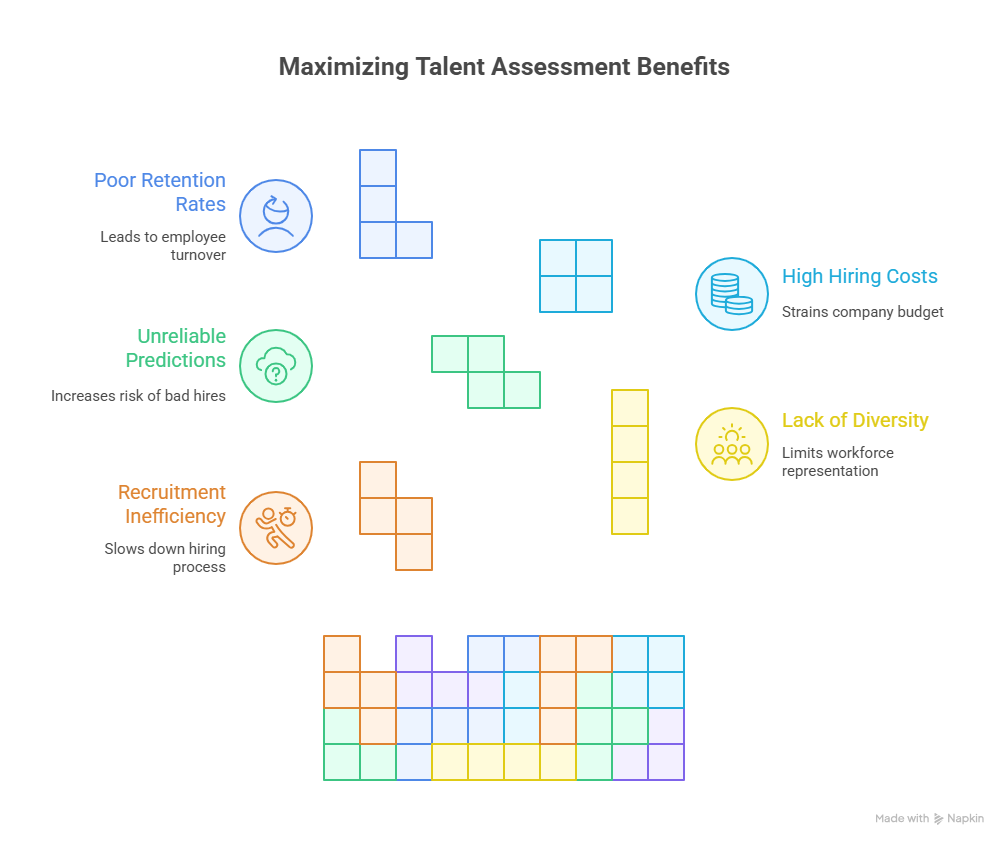
Speed is essential in competitive hiring markets. Talent assessments allow recruiters to quickly filter out unqualified candidates, ensuring only the most suitable move forward.
According to LinkedIn’s 2024 Global Talent Trends report, companies using assessments experience a 36% faster time-to-hire compared to those relying solely on resumes and interviews. Automated assessments streamline early-stage screening, saving valuable time for both candidates and hiring teams.
Organizations like General Electric have successfully used digital assessments to accelerate their graduate recruitment programs, resulting in faster and more equitable hiring processes. By shortening the recruitment cycle, assessments not only save costs but also improve the candidate experience, reinforcing the employer brand.
2. Building a Diverse and Inclusive Workforce with Talent Assessments
Bias, whether conscious or unconscious, can significantly impact hiring decisions. Talent assessments introduce standardization, helping to create fair and equitable evaluation processes.
Research by McKinsey & Company shows that diverse organizations outperform their peers by 36% in profitability. Standardized assessments remove subjective bias by focusing on measurable criteria, ensuring all candidates are evaluated based on skills and potential.
Companies like Google use structured assessments and skills-based hiring to foster a more inclusive workplace. Implementing fair assessments supports diversity initiatives and aligns hiring practices with broader organizational values. Recruiters committed to building inclusive teams must integrate objective assessment tools into their recruitment strategy.
3. Providing Predictive Insights for Better Talent Management
Effective hiring goes beyond filling open roles—it’s about predicting candidate success and potential within the organization. Talent assessments provide predictive data that helps align hiring with long-term business goals.
Assessment tools can forecast an employee’s likelihood of success in a role by evaluating competencies that correlate with high performance. For example, leadership potential assessments can help identify future managers early in their careers.
Companies such as IBM leverage predictive hiring analytics to align talent acquisition with workforce planning. This approach enhances succession planning and drives better business outcomes. Investing in talent assessments sets the foundation for smarter workforce management and future-proofing your organization.
4. Reducing Hiring Costs with Talent Assessments
Making the wrong hire can be costly for organizations. Talent assessments minimize this risk by ensuring only qualified candidates progress through the hiring pipeline. According to the U.S. Department of Labor, a bad hire can cost up to 30% of the employee’s first-year earnings. Structured assessments help avoid costly recruitment mistakes by providing objective data on candidates’ skills and suitability.
Companies like Southwest Airlines use assessments to screen candidates efficiently, reducing turnover and saving significant recruitment and training expenses. By identifying the right talent early, organizations can optimize hiring budgets and achieve better ROI on recruitment investments.
5. Improving Employee Retention Through Better Hiring Decisions
Employees who are well-matched to their roles tend to stay longer and perform better. Talent assessments ensure that candidates align with both the job requirements and company culture.
Research by the Brandon Hall Group found that organizations using pre-hire assessments experience 39% lower turnover among new hires. These tools measure not only technical abilities but also behavioral traits, ensuring stronger job fit.
Companies like Zappos prioritize cultural fit assessments to maintain high retention rates and team cohesion. Using talent assessments strategically strengthens workforce stability and reduces the ongoing costs associated with employee turnover.
How Skillrobo Helps Simplify Talent Assessment
Skillrobo simplifies talent assessment by enabling HR teams to move away from fragmented, manual evaluation methods and adopt a structured, skills-first approach to hiring and development. The platform is designed to help organizations assess candidates and employees based on real capabilities rather than assumptions, making the entire talent assessment process more accurate, scalable, and consistent.
One of the key ways Skillrobo simplifies talent assessment is through role-based skill evaluations. HR teams can create assessments tailored to specific job roles, ensuring that candidates are evaluated on competencies that directly impact performance. This eliminates the need for generic tests and improves the relevance of assessment data, which is critical for making confident hiring decisions.
Skillrobo also streamlines the talent assessment process by automating test distribution and evaluation. Assessments can be shared easily through secure links or integrated into existing recruitment workflows, reducing administrative effort for recruiters. Automated scoring and instant reporting allow HR teams to review results quickly, identify high-potential candidates, and move qualified individuals forward without delays.
Another important advantage is assessment integrity. Skillrobo includes monitoring and proctoring features that help maintain fairness and reliability during evaluations. By tracking test behavior and preventing malpractice, HR teams can trust that assessment results accurately reflect a candidate’s true skill level.
Beyond hiring, Skillrobo supports broader talent management initiatives. Assessment data can be used to identify skill gaps, support internal mobility, and design targeted learning plans. The platform also enables employee skills self assessment, allowing organizations to combine self-reported insights with objective evaluation data for a more complete talent profile.
By centralizing assessments, reporting, and benchmarking in one platform, Skillrobo helps HR teams reduce manual effort, improve hiring accuracy, and build a data-driven talent strategy. This structured approach ensures talent assessments are not just easier to manage, but also more effective in supporting long-term workforce success.
Wrapping Up
Talent assessments are an important part of the hiring process. The importance of talent assessments can be understood from their multitude application, from recruitment to employee performance management. The talent assessment process can be used to hire skilled and competent candidates. The benefits of talent assessment include fast and accurate hiring, and skills-based hiring. Streamline your hiring process with pre-employment skill assessments in Skillrobo. Sign up now.
FAQs
1. What are talent assessments in recruitment?
Talent assessments evaluate candidates’ skills, cognitive abilities, and behavioral traits during the hiring process to predict job performance and cultural fit.
2. How do talent assessments improve diversity?
By standardizing evaluations, talent assessments reduce unconscious bias, enabling fairer hiring practices and supporting diversity and inclusion initiatives. Explore more on communication skills assessment tools.
3. Can talent assessments reduce time-to-hire?
Yes, assessments streamline candidate screening, helping recruiters quickly identify qualified candidates and significantly reduce time-to-hire.
4. Are talent assessments accurate predictors of job success?
When used correctly, assessments provide strong predictive insights into a candidate’s future performance, aligning hiring decisions with business needs.
5. How does Skillrobo support talent assessments?
Skillrobo offers AI-powered assessments with role-specific tests, real-time analytics, and secure monitoring features, helping HR teams improve hiring quality. Learn more about the pros and cons of recruitment methods.