Pre Employment Screening Test: Meaning, Steps, Types and Importance
There was a point in my HR career when I used to get nightmares of drowning in a pile of candidate resumes, desperately crying out for rescue!
Those were the times when I used to manually go through each resume to find a matching profile against the job description.
Now, I find the right match within a few minutes. What has changed? I started using pre-employment screening tests.
Pre-employment screening can reduce the time to hire by 50%. I can personally vouch for that.
Using pre-employment assessments has changed the way I go about the hiring process, by simplifying and accelerating the initial evaluation.
Read on to understand the steps and benefits of having a streamlined pre-employment screening process.
What is a Pre Employment Screening Test?
A pre employment screening test is an assessment used by employers to determine whether a candidate possesses the necessary skills, traits, and capabilities to perform a job effectively. It goes beyond resumes and interviews by providing measurable evidence of job fit, cognitive ability, personality style, ethical behavior, and real performance potential. These screening tools have become indispensable in modern hiring because they reveal insights that traditional evaluation methods may miss. Whether employers want to verify technical competence, assess problem-solving ability, measure honesty, or understand how a candidate handles pressure, the pre employment screening test offers a structured and unbiased way to evaluate talent.
This comprehensive guide explains the meaning of a pre employment screening test, describes the full pre employment screening process, explores more than 12 different employment tests, provides pre employment test examples and sample questions, explains how to pass a pre employment screening test, and highlights the importance of personality test pre employment screening and integrity tests. Additionally, we discuss how employers use these assessments and how modern pre employment testing companies support large-scale hiring.
What is the Pre Employment Screening Process?
The pre employment screening process is a foundational component of modern hiring strategy. It encompasses all activities and evaluative measures taken by an organization to determine whether a candidate is suitable for a specific role. Unlike surface-level resume evaluations or traditional interviews, this process explores the deeper layers of a candidate’s professional background, technical expertise, behavioral tendencies, and credibility.
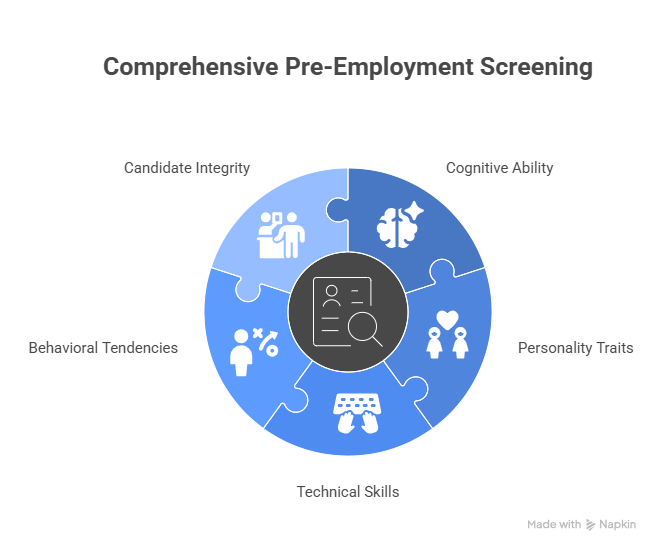
Most organizations today cannot rely exclusively on resumes or interviews due to the increasing competitiveness of recruitment markets and the rising number of candidates who embellish or exaggerate qualifications. A structured screening process helps create clarity, reducing uncertainty and ensuring consistency across all hiring decisions. Each part of the screening process acts like a checkpoint, validating different aspects of a candidate’s profile before moving them further down the hiring pipeline.
Companies use various tools and techniques such as skill assessments, psychometric tests, background checks, educational verification, and personality evaluations. Together, these components create a 360-degree perspective on the candidate. This holistic approach minimizes blind spots and strengthens decision-making.
When examined from an HRM perspective, the pre employment screening process meaning goes beyond simple verification. It is a strategic exercise linked to talent management, risk mitigation, workforce planning, and organizational culture improvement. HR departments continuously refine screening frameworks to stay aligned with business needs and regulatory standards.
Steps in the Pre Employment Screening Process
The pre employment screening process is an organized, step-by-step framework that evaluates a candidate’s readiness and fit for a job. Although companies tailor the process to their needs, most follow a common structure that ensures fairness, accuracy, and consistency.
Step 1: Identifying Required Competencies
Before administering tests, employers define the competencies needed for the role. These include technical abilities, cognitive strengths, communication skills, behavior traits, ethics, teamwork, and learning agility. Clear competency mapping ensures that tests evaluate relevant attributes.
Step 2: Selecting Suitable Tests
Employers choose test types based on the job role. For example:
- Customer service roles require communication and empathy assessments
- Finance roles require numerical reasoning tests
- Technical roles require skill-based assessments and simulations
- Leadership roles require personality and decision-making tests
This selection ensures the screening process remains job-relevant.
Step 3: Administering Screening Tests
Tests may be conducted online or in test centers. Most organizations prefer online assessments because they are scalable, secure, and convenient. Candidates receive instructions, time limits, and test guidelines before beginning.
Step 4: Analyzing Assessment Results
Screening platforms provide automated scoring, competency breakdowns, percentile rankings, behavioral insights, and test reports. Employers use this data to identify top performers and eliminate unqualified applicants early.
Step 5: Conducting Interviews and Additional Evaluations
Hiring managers use screening results to guide interview questions, ensuring deeper exploration of strengths or concerns discovered during testing. This makes interviews more focused and meaningful.
Step 6: Making the Hiring Decision
Test results, interview performance, cultural fit, and references are combined to make the final hiring decision. Data-driven insights reduce guesswork and improve the likelihood of selecting the right candidate.
Step 7: Onboarding and Training
Once hired, assessment feedback helps shape personalized training programs during onboarding.
The pre employment screening process creates a structured hiring journey that benefits both employers and candidates by emphasizing fairness, accuracy, and predictive success.
Types of Pre Employment Tests
Pre employment tests are not one size fits all. The level of the role determines the type of assessment required. Entry level positions focus on foundational skills and aptitude, mid level roles emphasize applied expertise and problem solving, while senior level hiring requires strategic evaluation and leadership validation.
Here is how organizations typically categorize pre employment tests based on role seniority.
Entry Level Roles: Foundational Skill and Aptitude Testing
For entry level positions, employers prioritize potential over experience. These candidates may not have an extensive work history, so assessments focus on core abilities.
Common tests include:
Cognitive ability tests to measure logical reasoning and learning capacity
Basic technical or domain knowledge assessments
Communication and language proficiency tests
Situational judgment tests to evaluate decision making in structured scenarios
The goal at this stage is to identify candidates who demonstrate strong learning agility, clarity of thinking, and the ability to adapt quickly to structured environments.
Mid Level Roles: Applied Skill and Performance Based Assessments
Mid level hiring requires validation of practical expertise. These professionals are expected to manage responsibilities independently and deliver measurable outcomes.
Pre employment tests for mid level roles often include:
Role specific technical assessments or case studies
Job simulations that replicate real work scenarios
Problem solving and analytical reasoning tests
Behavioral assessments to evaluate collaboration and accountability
At this level, employers assess not just knowledge but execution capability. The focus shifts from potential to proven performance readiness.
Senior Level Roles: Strategic, Leadership, and Decision Making Evaluation
Senior level hiring carries higher risk and impact. Resumes and interviews alone rarely provide enough insight into leadership effectiveness.
Pre employment tests for senior roles may include:
Executive level situational judgment assessments
Leadership style and personality profiling
Strategic case simulations
Decision making and risk evaluation exercises
These assessments are designed to evaluate vision, judgment, stakeholder management, and long term strategic thinking. For leadership positions, predictive validity and behavioral alignment become critical selection factors.
By aligning pre employment tests with job seniority, organizations ensure that assessment methods match responsibility levels, improving hiring accuracy and long term performance outcomes.
Essential Pre-Employment Screening Techniques for Entry-Level Hiring
Hiring for entry-level roles requires a custom pre-employment assessment process that caters to skill requirements at early career stage. Right from technical evaluation to behavioral assessment, the evaluation needs to be at the basic level. Here, we have put together a set of tests that are specific to entry-level position hiring.
Background Checks
Background checks verify the authenticity of a candidate’s education, employment history, and criminal records. Although entry-level candidates may have limited work experience, education verification is crucial.
According to a Checkr report, discrepancies in resumes are common even for junior roles. A thorough background check helps organizations maintain integrity in their hiring process.
Tip: Partner with compliant third-party vendors to perform legal and comprehensive background screenings without breaching candidate privacy.
Skills Assessment Tests
Skills assessments evaluate practical abilities, ensuring candidates can perform the core tasks required for the role. For entry-level hiring, assessments should focus on foundational skills like communication, critical thinking, and technical aptitude.
Platforms like Skillrobo’s pre-employment skill testing allow organizations to create customized tests that match job requirements. This ensures an objective evaluation of candidate capabilities before extending an offer.
Pro Tip: Administer role-specific assessments early in the hiring funnel to filter candidates efficiently.
Cognitive Ability Tests
Cognitive tests measure problem-solving skills, attention to detail, and logical reasoning. These are key predictors of job performance, especially in fast-evolving industries.
Skillrobo’s cognitive assessment tests offer AI-based evaluations to objectively measure a candidate’s mental agility, a crucial trait for entry-level hires expected to learn quickly.
Insight: Organizations using cognitive tests report 24% higher productivity among their hires, according to a recent study published by the Harvard Business Review.
Behavioral Assessments
Behavioral assessments predict how a candidate is likely to act in different workplace scenarios. For entry-level roles, adaptability, teamwork, and coachability are vital traits.
Skillrobo’s behavioral assessments help recruiters identify candidates’ interpersonal skills and workplace behavior patterns, supporting better cultural fit decisions.
Tip: Use behavioral assessments in tandem with interviews to corroborate findings and gain a fuller picture of the candidate.
Online Proctored Testing
Online proctored assessments maintain the integrity of remote testing by monitoring candidates during evaluations.
While Skillrobo uses Seyarc AI for question creation only, the platform ensures secure, role-specific assessments that prevent dishonesty during remote evaluations. For more insights, visit online proctored exam types and benefits.
Recommendation: Communicate the proctoring process transparently to candidates to ensure a positive experience.
Pre Employment Screening Test Questions: What Candidates Should Expect
Candidates preparing for screening tests must understand the types of questions they may encounter. Pre employment screening test questions depend on the test type but commonly include:
- Logical reasoning patterns
- Numerical calculations
- Scenario-based ethical dilemmas
- Customer conflict resolution questions
- Multiple-choice personality items
- Grammar and comprehension exercises
- Task-based skill assessments
- Prioritization and scheduling questions
Candidates who practice regularly using pre employment screening test practice resources perform significantly better because they gain familiarity with test structure, pacing, and difficulty.
Common Pre Employment Screening Errors Organizations Overlook
One of the most common pre employment screening errors is relying too heavily on incomplete or outdated information. Background databases are not always updated in real time, and discrepancies can easily go unnoticed if verification steps are skipped. These inaccuracies often result in candidates being incorrectly flagged or cleared.
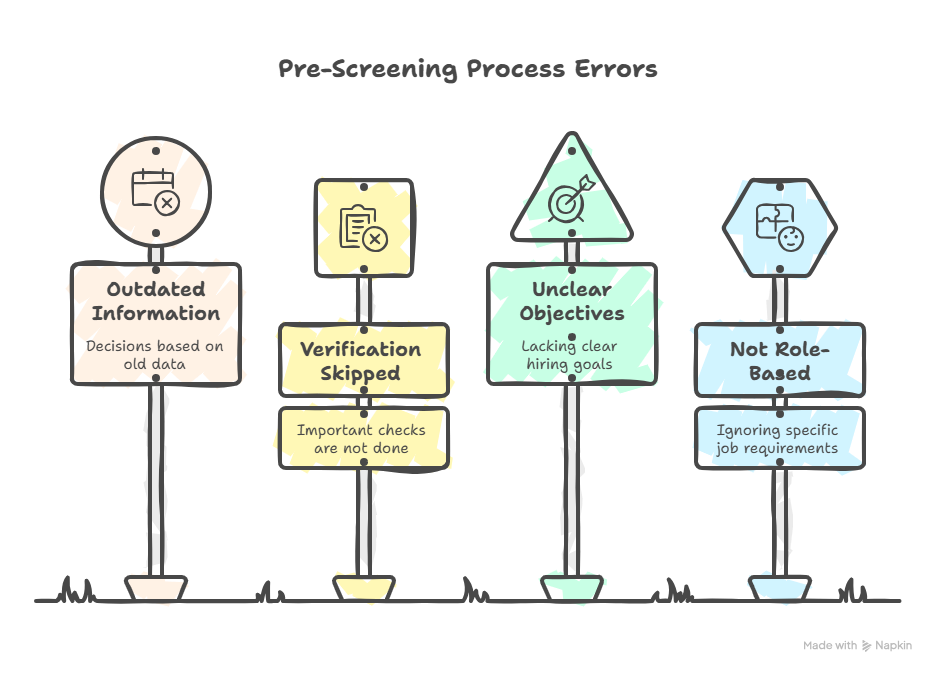
Another frequent error involves unclear screening criteria. When recruiters are unsure what constitutes a pass or fail, decisions become inconsistent. This is especially problematic in large organizations where multiple recruiters handle similar roles. Without standardized benchmarks, the same screening result may lead to different outcomes.
Lack of role-specific screening is another major issue. Organizations often apply uniform screening standards across diverse roles, ignoring the fact that different positions carry different levels of risk and responsibility. This approach leads to unnecessary disqualifications in some cases and insufficient scrutiny in others.
Importance of Pre-employment Screening Test
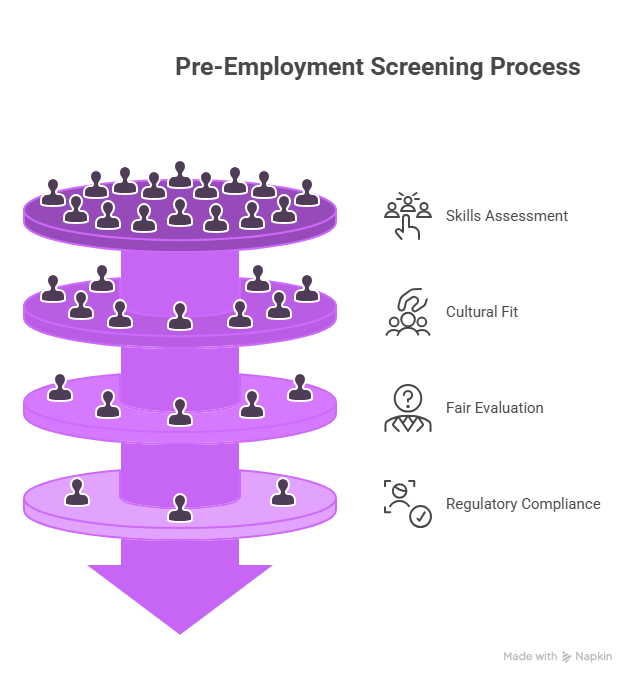
Recruitment today requires precision to navigate a flood of applications across industries. Pre-employment screening provides a systematic way to assess candidates, ensuring only those with the right skills and traits advance. For example, a logistics firm might test analytical skills for supply chain roles, while a creative agency evaluates innovation for design positions. Without screening, organizations risk hiring mismatches, which can disrupt workflows and morale.
Screening also fosters equity in hiring. Traditional resume reviews can favor polished applications over raw talent, introducing bias. Structured assessments focus on measurable abilities, leveling the playing field. This is vital in high-stakes sectors like healthcare, where competence ensures patient safety, or finance, where ethical decisions protect trust. By prioritizing screening, businesses align hiring with operational and ethical goals.
1. Aligning Skills with Job Demands
Effective hiring starts with ensuring candidates’ skills match the specific demands of a role, and pre-employment screening makes this possible through tailored evaluations. A software developer needs proficiency in languages like Python or Java, while a customer service rep requires strong interpersonal skills to handle client inquiries. Screening allows recruiters to test these exact competencies, avoiding the pitfalls of assuming a resume reflects true ability.
For instance, a retailer hiring for inventory management might use a test to assess numerical accuracy and attention to detail, these skills are critical for minimizing stock errors. Tools for evaluating candidate skills enable customization, letting recruiters design assessments that align with job-specific needs, whether it’s coding for tech roles or communication for sales positions. This precision ensures hires can perform their duties effectively from day one, reducing the risk of onboarding someone who looks qualified but lacks the practical expertise required, ultimately enhancing productivity and job fit.
2. Reducing Turnover Costs
Hiring the wrong person doesn’t just waste time, rather it hits the bottom line hard. The Society for Human Resource Management estimates replacing an employee can cost up to five times their salary, factoring in recruitment, training, and lost productivity. Pre-employment screening mitigates this by identifying candidates who are not only skilled but also likely to stay long-term, assessing both technical abilities and cultural alignment.
Consider a tech firm hiring a systems analyst: a screening test on problem-solving and adaptability can reveal if a candidate thrives under pressure, a key indicator of retention in fast-paced roles. Assessments for cognitive abilities on Skillrobo provide data to spot these traits early, helping avoid hires who might leave after a few months due to mismatched expectations or capabilities. By investing in screening, companies cut turnover costs and build stable teams, saving resources that would otherwise be spent on constant rehiring cycles.
3. Promoting Fair Hiring Practices
Subjectivity in hiring, like favoring candidates with impressive resumes or alma maters, can unintentionally exclude diverse talent with untapped potential. Pre-employment screening counters this by focusing on performance metrics rather than pedigree, ensuring every applicant gets a fair shot based on ability. This shift is crucial for building inclusive teams that bring varied perspectives to the table.
Take a call center hiring for support reps: a scenario-based test on problem-solving and empathy lets self-taught candidates shine, even without formal credentials, over those with polished applications but weaker skills. Solutions for fair hiring practices emphasize measurable outcomes, reducing bias and opening doors for underrepresented groups. This not only aligns with ethical hiring goals but also drives innovation by tapping into a broader talent pool, strengthening organizational resilience and creativity.
4. Ensuring Regulatory Compliance
In regulated industries, hiring unqualified candidates isn’t just inefficient, it’s a legal risk. Pre-employment screening verifies that candidates meet mandatory standards, protecting organizations from compliance violations. Financial firms might test knowledge of anti-money laundering protocols to ensure ethical handling of transactions while manufacturing roles could require awareness of safety regulations to prevent workplace incidents.
For example, a healthcare provider hiring nurses might screen for patient care protocols to comply with industry guidelines, ensuring patient safety isn’t compromised. By confirming qualifications and competencies upfront, screening acts as a safeguard against penalties or reputational damage. Role-specific assessments can be tailored to include these checks, giving recruiters confidence that hires meet both job and regulatory demands, and maintaining trust and operational integrity.
Pre Employment Screening with Skillrobo
Skillrobo enhances pre employment screening by offering a comprehensive, customizable, and data-driven assessment ecosystem designed to help employers make informed hiring decisions with confidence. Unlike traditional testing methods that provide only surface-level insights, Skillrobo enables employers to evaluate candidates across cognitive, technical, behavioral, and role-specific competencies through scientifically validated assessments. The platform includes pre-built test libraries, instant scoring, AI-driven analytics, and secure proctoring tools that ensure authenticity and fairness throughout the screening process. For organizations that need tailored evaluations, Skillrobo offers customizable question banks and workflow-driven assessments that can mirror real on-job scenarios.
Skillrobo’s strength lies in its accuracy and scalability. Whether a business hires for five positions or five hundred, the platform can screen candidates efficiently without compromising quality. Recruiters benefit from reduced manual workload because Skillrobo automatically evaluates responses, generates performance summaries, and highlights top candidates based on competency match. This eliminates guesswork and speeds up hiring significantly. Additionally, Skillrobo’s behavioral assessments, integrity tests, and personality evaluations provide deeper insights that go beyond technical qualifications, helping organizations build teams that perform consistently and align with company culture.
Another major advantage is Skillrobo’s remote assessment capability. With secure browser controls, AI monitoring, webcam tracking, and plagiarism checks, the platform ensures that online tests remain trustworthy and cheat-proof. This makes Skillrobo ideal for distributed teams, remote hiring, and global recruitment processes. Ultimately, Skillrobo empowers businesses with an end-to-end pre employment screening solution that is affordable, predictive, accurate, and aligned with modern hiring needs.
Pre Employment Screening Test Practice: Why Candidates Need It
Regular practice improves speed, accuracy, and confidence. Candidates accustomed to reasoning questions, personality assessments, and situational judgment tests are more likely to perform well. Practice also helps reduce test anxiety, which can interfere with performance. More importantly, familiarity with test formats ensures candidates approach assessments strategically rather than reactively.
Conclusion
Pre employment screening tests have become essential in modern hiring because they bring structure, objectivity, and predictability to the selection process. These assessments help employers evaluate skills, personality, integrity, cognitive abilities, and behavioral tendencies that influence job success. By implementing a robust pre employment screening process, companies improve hiring accuracy, reduce turnover, and build stronger teams.
Candidates benefit as well by gaining fair opportunities to demonstrate real competence. As hiring becomes more competitive, both employers and job seekers must understand and embrace screening tests as an integral part of the employment landscape. Skillrobo streamlines the pre employment screening process with AI-powered pre employment skill assessments. Sign up for the demo to explore further.
FAQs
1. How reliable are pre employment screening tests in predicting job performance?
Pre employment screening tests are highly reliable when they are professionally designed, scientifically validated, and aligned with job competencies. Cognitive tests, behavioral assessments, and skills evaluations often correlate strongly with real job performance.
2. Do candidates need to prepare for a pre employment screening test?
While many tests evaluate natural ability and consistent behavioral traits, candidates benefit greatly from preparing in advance. Practicing logical reasoning, situational judgment, and basic numerical skills can help improve speed and accuracy.
3. Can pre employment tests be customized for specific roles?
Yes, many organizations prefer customized assessments to evaluate role-specific knowledge and on-the-job skills. Custom tests ensure candidates are assessed on competencies that directly impact job success.
4. Are online pre employment screening tests secure and cheat-proof?
Modern assessment platforms use advanced anti-cheating features such as browser lockdown, webcam monitoring, facial recognition, plagiarism detection, and AI-driven proctoring to ensure test integrity. These measures prevent unauthorized assistance, tab switching, impersonation, and use of external resources.
5. What types of roles benefit most from pre employment screening tests?
Almost every role can benefit from structured screening tests because they measure skills and traits that influence job performance. Customer service roles benefit from empathy and communication assessments, technical roles rely on coding or domain knowledge tests, managerial roles require behavioral and situational judgment analysis.