AI Proctor Exam: The Future of Secure, Scalable, and Fair Online Assessments
Key Takeaways
- AI proctoring software provides automated, intelligent monitoring that safeguards exam integrity without relying on human invigilators.
- AI proctored exams use machine learning, facial recognition, environmental analysis, and behavior detection to ensure fairness in remote assessments.
- The AI proctor exam model scales effortlessly, enabling universities, enterprises, and certification bodies to test candidates globally with minimal manual oversight.
- AI proctor exams can utilize AI-driven proctoring, automated proctoring, and live proctoring, each offering different levels of monitoring, automation, and human involvement to suit various exam security needs.
- AI exam proctoring improves accessibility, strengthens anti-cheating measures, and delivers unbiased evaluation through high-accuracy behavioral analytics.
- As remote learning and online recruitment increase, AI remote proctoring will become the standard for secure, credible, and convenient online exams.
Introduction
Exam integrity has always been a cornerstone of credible education, talent evaluation, and professional certification. Traditionally, this integrity was maintained through in-person proctors who supervised candidates throughout the exam. But with organizations and educational institutions moving toward digital assessment models, it has become increasingly difficult to replicate the same level of security and control in remote environments. This is where the rise of AI proctor exam technology has made a transformational difference.
AI proctoring has reshaped how assessments are conducted by providing automated, intelligent supervision capable of monitoring hundreds or thousands of candidates at once. Today, exams are frequently administered online, requiring robust proctoring solutions to maintain integrity. Whether it’s a university entrance test, a professional certification exam, or a pre-employment skill evaluation, AI proctoring software ensures that every exam remains fair, secure, and free from misconduct. Unlike human proctors who can overlook subtle cues or experience fatigue, AI proctoring continuously monitors behavior, analyzes patterns, detects anomalies, and flags suspicious activity in real time.
With the increasing popularity of remote education, work-from-home models, and global recruitment, the demand for AI for exams has surged. Organizations need fast, reliable, and consistent assessment environments that do not depend on physical presence. AI proctored examination tools provide this scalability, enabling exam administrators to maintain strict security standards regardless of where candidates are located.
This expanded blog provides an in-depth look at what AI proctoring is, how AI proctored exams work, its powerful benefits, the challenges it solves, and how solutions like Skillrobo help organizations maintain exam credibility without compromising on candidate experience.
An AI proctored exam is an online assessment that uses artificial intelligence to monitor test-taking behavior, enforce exam rules, and detect cheating automatically. Online proctoring leverages these AI technologies to secure remote assessments. Instead of relying on human invigilators to supervise candidates, the system uses advanced algorithms to watch every candidate continuously through their webcam, audio input, and screen activity.
The AI proctored exam meaning goes beyond basic monitoring. It involves identity verification, biometric analysis, environmental scanning, browser lockdown features, and automated behavior detection. Machine learning models analyze everything from eye movement patterns and head position to background noise and window switching. If the system identifies behavior that violates exam rules, it flags the event for the administrator to review.
AI proctored tests are designed to balance security with convenience. Candidates can take their exams from any location, but the integrity of the assessment remains uncompromised. This flexibility is why AI remote proctoring is now widely used in online learning, corporate training, certification programs, and pre-employment skill assessments.
Why AI for Exams Is Becoming the Global Standard
Online education and digital talent evaluation are not temporary trends. They represent a permanent shift in how individuals learn, work, and grow in their careers. AI for exams is quickly becoming the preferred method for conducting secure and scalable remote assessments for several reasons. AI proctored exams can be taken on demand, providing candidates with maximum flexibility.
First, traditional in-person exam centers limit accessibility. Candidates must travel, schedule around exam center availability, and incur additional costs. AI proctoring removes these barriers, allowing assessments to be conducted anytime and anywhere with the same level of security.
Second, human proctors cannot monitor hundreds of candidates simultaneously with full accuracy. They may miss subtle signs of cheating or struggle to supervise remote candidates effectively. AI proctoring software overcomes these limitations by providing continuous, unbiased monitoring with high accuracy across all test-takers.
Third, AI proctor exam systems significantly reduce operational costs. Institutions save money on physical infrastructure, manual proctoring staff, and administrative coordination. The automated nature of AI proctoring enhances efficiency and shortens the evaluation cycle.
Finally, AI proctored examinations support fairness and consistency. Every candidate is monitored through the same criteria, eliminating concerns about proctor subjectivity or inconsistent enforcement of rules. This reliability is especially critical for certification programs, high-stakes exams, and pre-employment testing.
How Do AI Proctored Exams Work?
AI proctored exams rely on a blend of artificial intelligence, computer vision, and behavioral analytics to monitor candidates throughout the assessment. The process involves several stages, each designed to strengthen security and deliver seamless exam experiences.
During each test session, the AI system continuously monitors and records the candidate’s activity to ensure exam integrity.
1. Pre-Exam Identity Verification
Before the test begins, candidates undergo identity verification using:
- Facial recognition comparison
- Government ID verification
- Liveness detection to ensure the examinee is physically present
This prevents impersonation and ensures that only authorized candidates access the exam.
2. Exam Environment Setup
Candidates may be asked to rotate their camera around the room so the AI can detect any unauthorized materials, additional screens, or individuals in the background. This step builds a baseline environment for continuous monitoring.
3. Continuous Video and Audio Monitoring
During the exam, the AI monitors:
- Eye movements
- Head orientation
- Facial expressions
- Mouth movement patterns
- Background noises
- Lighting changes
- Object shapes and hand gestures
Machine learning models evaluate whether these behaviors indicate normal test-taking or potential cheating.
4. Screen Monitoring and Browser Controls
AI remote proctoring also tracks screen activities, including:
- Attempts to open new browser tabs
- Copy-pasting text
- Navigating away from the exam window
- Launching unauthorized applications
- Opening external documents
Some systems include full browser lockdown tools.
5. Real-Time Cheating Detection
The system detects behavior anomalies such as:
- Looking repeatedly in different directions
- Whispering or speaking quietly
- Sudden changes in posture
- The presence of another person
- Use of external devices
When such activity is detected, the AI generates flags with timestamps. Administrators then review these flags to determine if a violation has occurred.
6. Post-Exam Reporting
At the end of the exam, AI proctoring software presents a complete report summarizing:
- Suspicious behavior incidents
- Severity levels
- Video clips of flagged events
- Candidate behavior score
- Trust score indicating the likelihood of exam integrity violations
Administrators can review the report to make informed decisions about exam validity.
This entire process ensures fairness, security, and consistency at scale.
Can AI Proctored Exams Detect Phones?
Yes, modern AI proctoring systems are capable of detecting phone usage, even when partially hidden. The software identifies phone-related cheating through several methods:
- Recognizing rectangular handheld objects
- Tracking unnatural downward glances
- Detecting arm movements associated with texting
- Recognizing reflections from phone screens
- Picking up audio cues such as tapping or notifications
In some platforms, the AI also detects signals from electronic devices if integrated with additional sensors. If the candidate tries to consult a phone during the test, the AI logs it as a potential violation.
Key Features of AI Proctoring Software
AI proctoring software offers robust features as part of comprehensive proctoring solutions to create secure, fair, and scalable testing environments.
Identity Authentication
By using facial recognition, ID verification, and biometric matching, the system ensures that only the correct candidate takes the exam.
Browser Locking and Screen Restriction
The system prevents access to other tabs, applications, or websites during the exam.
Audio and Video Analytics
Continuous monitoring helps analyze suspicious behavior or conversations.
Object Detection
The AI proctoring software can identify external devices, books, papers, or other prohibited materials within the environment.
Behavior Monitoring
Subtle movements, repeated glances, or posture shifts can indicate cheating attempts.
Real-Time Alerts and Flagging
If the system detects anomalies, it captures the moment with video proof and assigns a risk score.
Automated Reporting
After the exam, a detailed misconduct report is generated and sent to administrators for review. The report may also include candidate scores for further evaluation.
Benefits of AI Proctored Examination
AI proctored examinations offer transformative benefits that make them ideal for modern digital assessment environments. By leveraging advanced technology, AI proctoring enables better assessments by improving fairness and reducing opportunities for cheating.
Enhanced Security
AI systems detect cheating through multiple layers of monitoring, making exams more secure than many traditional proctoring methods.
Scalability and Efficiency
Institutions can proctor hundreds or thousands of candidates simultaneously without needing additional staff.
Flexible Exam Schedules
Candidates can take exams at any time and from any location.
Cost Savings
Organizations save on venue rentals, staffing, logistics, and travel arrangements.
Bias-Free Evaluation
AI systems operate consistently across all candidates, reducing the possibility of human error or bias.
Faster Review and Results
Automated scoring and behavior reporting help administrators save time and accelerate results.
Better Candidate Experience
With fewer onsite constraints and more flexible schedules, candidates can perform better under reduced stress.
These advantages make AI proctored exams the preferred choice for many organizations worldwide.
Common Misconceptions About AI Proctor Exams
Despite their widespread benefits, some misconceptions about AI proctored examinations persist.
A common misconception is that AI proctoring is excessively intrusive. In reality, AI only monitors what is necessary to verify exam integrity and follows strict data privacy guidelines.
Another misconception is that AI replaces human oversight. While AI handles monitoring, final decisions remain with administrators.
Some candidates believe they need expensive equipment. However, most AI proctored exams require only a standard laptop, webcam, microphone, and internet connection.
By clarifying these misconceptions, organizations can ensure smoother adoption and improved trust in AI exam proctoring systems. However, some candidates may still be hesitant to accept AI proctoring due to concerns about data privacy or potential bias, which can affect their willingness to trust these systems.
Challenges Solved by AI Proctor Exam Technology
Traditional exam environments, whether conducted physically or online, have long struggled with issues that compromise fairness, scalability, and efficiency. As remote learning, global recruitment, and digital certification programs continue to grow, these challenges have become even more pronounced. AI proctor exam technology directly addresses these deep-rooted limitations by providing intelligent, automated, and highly scalable monitoring capabilities. The solution not only ensures exam integrity but also transforms the entire assessment process into a streamlined, accessible, and globally manageable ecosystem.
One of the biggest challenges in remote assessment is the inability to maintain consistent supervision across all candidates. Human proctors, even when monitoring online video feeds, can only observe a limited number of test-takers at once and may miss subtle cues of misconduct. Fatigue, distraction, and human error introduce inconsistencies, creating gaps in security. AI proctoring eliminates this challenge by offering continuous, unbiased surveillance without breaks or lapses. It monitors every second of exam activity with precision, analyzing eye direction, object presence, background sounds, and screen activity simultaneously for all candidates. This level of consistency simply cannot be matched by manual invigilation.
Geographical barriers pose another significant challenge for traditional exam setups. Physical test centers require candidates to travel, sometimes across long distances, which increases cost, logistical complexity, and accessibility issues. This creates inequality, as some candidates may not have the means or ability to attend exam centers. AI proctored tests solve this problem by enabling exams to be taken from any location while maintaining strict proctoring standards. Whether a student is in a remote village or an employee is working from another country, AI remote proctoring ensures that everyone has equal access to secure assessments.
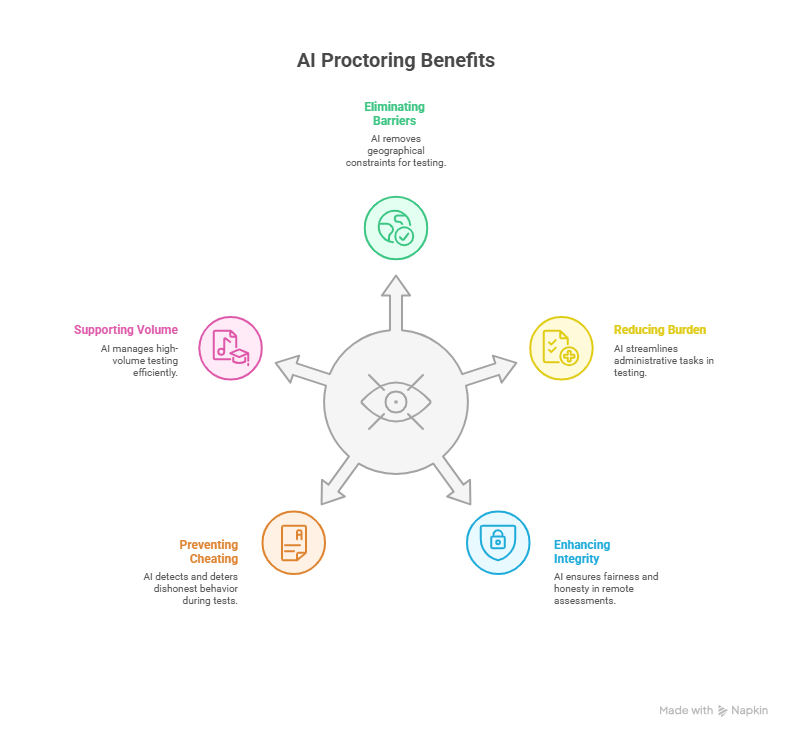
Exam logistics also create administrative strain for institutions conducting large-scale assessments. Coordinating schedules, managing proctors, arranging venues, and handling compliance demands significant time and resources. AI proctor exam systems reduce this burden by automating identity verification, monitoring, and reporting. Administrators no longer need to manage large teams of invigilators or coordinate physical exam centers. The automation simplifies scheduling, shortens evaluation cycles, and minimizes administrative overhead, freeing up resources for more strategic tasks such as content development or learner support.
Cheating in exams has historically been difficult to detect in both physical and virtual environments. In traditional classrooms, human proctors may fail to notice covert attempts to consult hidden notes or use mobile devices. In remote settings, opportunities for cheating are even wider due to lack of visibility into the candidate’s environment. AI proctoring solves this challenge through advanced behavioral analytics and object detection. The system identifies suspicious activities by analyzing patterns such as frequent glances away from the screen, sudden movements, unusual noises, the presence of additional individuals, or the use of prohibited devices. It handles multiple detection layers simultaneously, making cheating significantly harder to execute and easier to identify.
Another challenge AI proctoring solves is the bias that may occur with human supervision. Human invigilators may interpret behavior differently based on personal judgments, cultural contexts, or unconscious biases. AI, on the other hand, applies standardized rules across all candidates. It flags behavior objectively and consistently, ensuring that no candidate is unfairly targeted or overlooked. This fairness is especially crucial in high-stakes exams where a candidate’s career or academic future may depend on the outcome.
Scalability has always been a barrier in traditional testing models. Large organizations or universities conducting mass examinations struggle to provide adequate monitoring due to limited human proctor availability. Scaling manual invigilation is expensive, time-intensive, and highly impractical. AI proctoring solves this by offering infinite scalability, allowing thousands of candidates to take examinations simultaneously without compromising supervision quality. This flexibility supports global recruitment drives, nationwide examinations, and certification tests that require high-volume participation.
Maintaining detailed documentation and evidence of misconduct is another challenge that AI proctoring technology addresses. During manual exams, proctors may hesitate to report incidents or may not have clear proof of cheating. AI systems produce timestamped videos, behavior logs, incident heatmaps, and detailed reports that allow administrators to make informed decisions. This strengthens accountability, transparency, and the credibility of exam results.
Finally, candidate verification is a recurring challenge, especially in remote assessments. Without reliable identity checks, institutions cannot confirm whether the registered candidate is the one taking the exam. AI proctoring solves this through biometric authentication methods such as facial recognition, ID matching, and liveness detection. These steps ensure that impersonation is not possible, thereby protecting exam integrity.
By solving these critical challenges, AI proctor exam technology creates a secure, equitable, and scalable assessment environment. It empowers organizations to uphold high standards of fairness and reliability while simultaneously modernizing their examination processes for a global digital audience.
AI Proctoring in Recruitment, Certifications, and Skill Testing
AI remote proctoring is now widely used across industries.
In recruitment, AI proctored exams verify candidate authenticity and ensure skill assessments are completed without external assistance. AI proctoring can also be used for quizzes and other short-form assessments to ensure integrity.
In certification programs, worldwide learners can earn credentials securely without visiting physical test centers.
In corporate upskilling, employees undergo proctored assessments to validate knowledge acquisition after training programs.
AI exam proctoring has become integral to every stage of the talent lifecycle.
The Future of AI Proctored Exams
AI proctoring will continue to evolve with advancements in computer vision, behavioral biometrics, and predictive analytics. Future AI systems will distinguish better between accidental behaviors and intentional cheating. They may offer personalizable monitoring levels based on exam complexity or candidate risk.
Integration with VR-based testing environments may become standard, creating immersive exam experiences that eliminate external assistance completely. Future assessments are likely to become more creative, incorporating open-ended and practical tasks to better evaluate genuine understanding.
Hybrid models combining live proctors with AI intelligence will enhance credibility, especially for high-stakes professional certifications.
As technology progresses, AI proctor exams will become the global standard for secure, equitable, and accessible assessment ecosystems.
How Skillrobo Supports AI Proctored Exams
Skillrobo provides secure, intuitive, and intelligent AI proctored exam capabilities that help organizations conduct remote assessments with confidence. Its AI proctoring solution includes identity verification, behavioral monitoring, audio-video analysis, and advanced cheating detection.
Skillrobo’s automated reporting system ensures administrators receive clear, factual insights into candidate behavior, enabling fair and accurate decision-making. The platform is designed for scalability, making it ideal for enterprise recruitment, certification testing, academic evaluations, and workplace upskilling.
Skillrobo ensures exam integrity while supporting seamless, user-friendly assessment experiences aligned with industry standards.
Wrapping Up
AI proctor exam technology is transforming how organizations conduct secure and credible online assessments. By combining machine learning, biometrics, and intelligent behavior monitoring, AI proctored exams ensure that remote evaluations maintain the same integrity as traditional in-person tests. As online education and digital recruitment continue expanding, AI proctoring will become an essential part of every assessment strategy.
Choose Skilrobo for remote proctoring for pre-employment skill assessments. Sign up for the free trial now.
FAQs
1. What is an AI proctored exam?
An AI proctored exam is an online assessment monitored using artificial intelligence, which analyzes behavior, environment, and system activity to ensure fairness and detect cheating.
2. How do AI proctored exams work?
AI proctored exams use webcam monitoring, audio analysis, identity verification, browser restrictions, and behavioral detection algorithms to supervise candidates throughout the exam.
3. Can AI proctored exams detect phones?
Yes, AI systems detect phones through movement analysis, object detection, audio cues, and screen reflections. These cues help identify whether the candidate is using a mobile device during the exam.
4. Is AI proctoring secure and private?
Yes, AI proctoring uses encrypted channels, strict privacy settings, compliance frameworks, and access controls to ensure candidate data security.
5. How does Skillrobo support AI proctored exams?
Skillrobo provides AI-powered monitoring, automated behavioral flagging, identity checks, and secure reporting, making it ideal for pre-employment testing, certifications, and academic assessments.