Staffing Agency Software – Top 10 Staffing Software Solutions for 2026
TL;DR
- Staffing agency software helps recruiters automate the entire hiring process, from sourcing to placement.
- The right software enhances productivity, candidate experience, and client relationship management.
- Cloud-based staffing systems provide real-time data, analytics, and workflow automation for recruiters.
- Skillrobo offers end-to-end automation for staffing agencies, improving efficiency, accuracy, and candidate matching.
Staffing agencies have their task cut out. Their focus is no longer limited to building a skilled and competent workforce, they are expected to build candidate databases, engage in collaborative hiring, manage client relationships, and also take care of billing and payroll.
Handling such a vast scope of responsibilities requires automation at various stages of recruitment. How to automate recruitment processes in staffing agencies? Staffing agency software to the rescue!
Staffing agency software empowers recruiters with automation, centralized data, and real-time insights. It eliminates repetitive tasks, streamlines communication, and helps staffing professionals focus on what truly matters.
This requires connecting top talent with the right opportunities. Staffing agency software has become an indispensable tool for agencies looking to hire smarter and faster.
What is the best staffing agency software for recruiters? What are the key features to look for in staffing agency software? Learn what staffing agency software is, why it is essential, the key features that make it effective, and the benefits of using cloud-based staffing software.
An added bonus is a comparison of top staffing software tools, which helps HR professionals make informed decisions on choosing the best staffing agency software for their agency in the upcoming year.
What is Staffing Agency Software and How Does It Work
Staffing agency software is a comprehensive digital platform designed to manage and automate recruitment workflows for staffing firms. It acts as an all-in-one system that handles candidate sourcing, resume management, client communication, job postings, scheduling, and payroll management.
The software typically integrates various tools into one interface, enabling recruiters to oversee every stage of the staffing process without switching between multiple systems. From posting job openings to onboarding new hires, every action is streamlined through automation.
Most modern staffing platforms are cloud-based, meaning they can be accessed anytime, anywhere, and offer scalability to handle multiple clients, roles, and candidates simultaneously. This accessibility is crucial for today’s hybrid and remote work environments, allowing recruiters to collaborate seamlessly and make data-driven hiring decisions.
How Staffing Software Helps Recruitment Agencies Streamline Hiring
Recruitment agencies operate in an environment where time, precision, and efficiency are everything. The modern staffing industry faces increasing pressure from clients to fill roles faster, maintain transparency, and ensure the best quality of hires, all while managing thousands of candidates and job orders simultaneously. Without the right technological support, this can become overwhelming, leading to missed opportunities, slow turnaround times, and inconsistent hiring outcomes.
Staffing software provides a structured, technology-driven solution that automates and optimizes every stage of the recruitment process. It acts as the central hub that connects recruiters, candidates, and clients, ensuring a seamless flow of information and tasks. By automating repetitive activities, tracking data, and improving communication, staffing software allows recruiters to focus on strategic priorities like candidate engagement and client satisfaction.
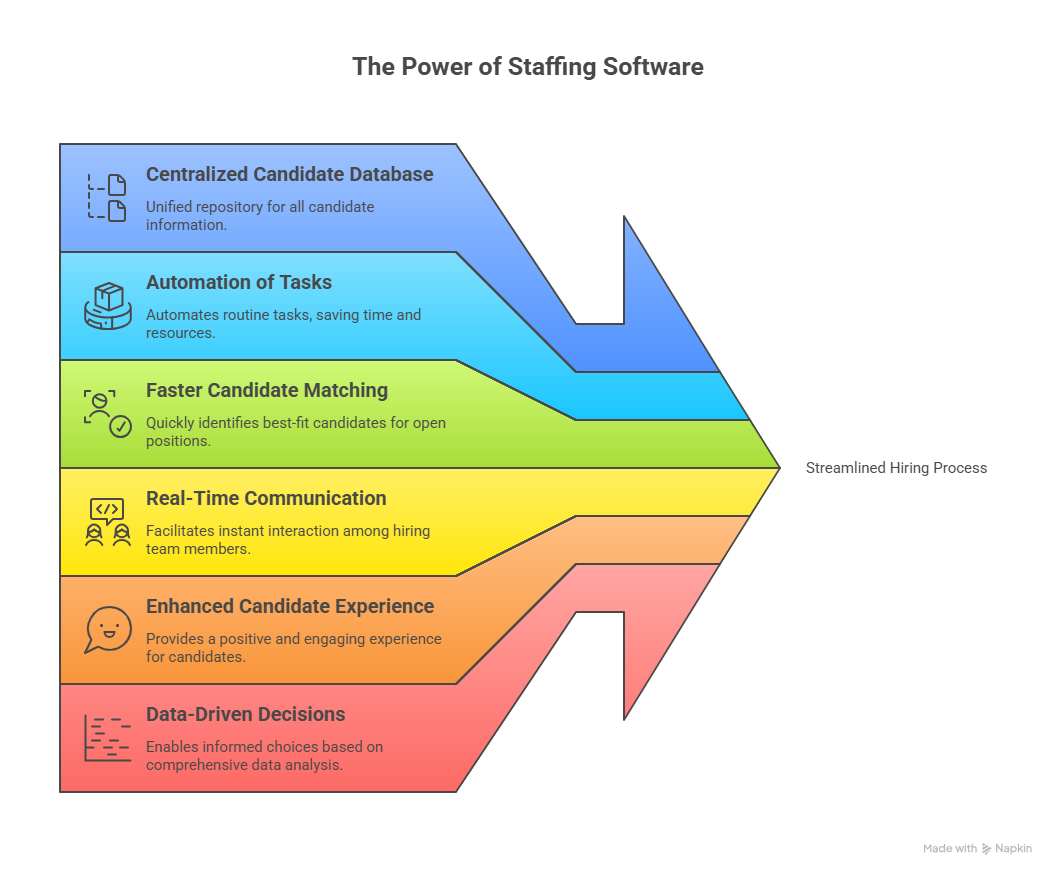
Here’s how staffing software helps agencies streamline and elevate their hiring process.
1. Centralized Database for Candidates and Clients
One of the biggest challenges staffing agencies face is managing vast amounts of data, which include candidate resumes, job orders, client communications, and interview schedules. Staffing software brings all this information into a single, centralized system. This eliminates the need for manual record-keeping or toggling between spreadsheets, emails, and job portals.
Recruiters can easily search, filter, and retrieve candidate profiles based on specific skills, experience, or availability. Similarly, client data such as billing details, job history, and feedback are stored in one place, making it easier to track and manage relationships. Centralization improves collaboration between team members and ensures that no information is lost in the process.
2. Automation of Repetitive and Time-Consuming Tasks
Traditional recruitment often involves a significant amount of manual work; from posting job ads on multiple boards to sorting through hundreds of resumes and following up with candidates. Staffing software automates these repetitive tasks, saving recruiters hours of manual effort.
For example, recruiters can automatically post job openings across multiple job portals with a single click. Resume parsing tools extract relevant information from applications and categorize candidates based on their qualifications and experience. Automated email communication tools send personalized responses, interview reminders, and status updates to candidates, reducing communication delays.
Automation not only speeds up the hiring process but also reduces the risk of human error, ensuring consistent quality and efficiency.
3. Faster and Smarter Candidate Matching
The heart of successful recruitment lies in finding the right fit between candidates and job openings. Staffing software leverages AI and machine learning algorithms to match candidates to roles based on skills, experience, and cultural fit.
Instead of manually scanning through resumes, recruiters receive a shortlist of top candidates who meet predefined criteria. Advanced analytics even consider soft skills, location preferences, and availability to ensure the best possible match. This intelligent automation reduces time-to-fill and enhances candidate quality, ensuring clients receive the most suitable applicants quickly.
4. Real-Time Communication and Collaboration
Recruitment is a collaborative effort that involves multiple stakeholders, including recruiters, hiring managers, clients, and candidates. Delayed communication can cause missed opportunities or poor candidate experiences. Staffing software integrates real-time communication channels that allow seamless coordination across teams.
Recruiters can schedule interviews, share candidate feedback, and track status updates instantly. Many platforms include built-in email, chat, and calendar integrations that keep everyone aligned. Clients receive live updates on candidate progress, while candidates stay informed about their application status, creating a transparent and responsive hiring experience.
5. Enhanced Candidate Experience
In the competitive job market, a positive candidate experience is a key differentiator for staffing agencies. Staffing software enables agencies to provide a smooth and engaging journey from application to onboarding.
Automated updates ensure candidates are informed at every stage, reducing uncertainty and improving satisfaction. Self-service portals allow applicants to upload resumes, track application status, and complete pre-screening forms conveniently. These features make candidates feel valued and respected, strengthening the agency’s reputation and encouraging referrals.
6. Data-Driven Decision Making and Analytics
One of the most powerful advantages of staffing software is the ability to collect and analyze data from every step of the hiring process. Recruiters can track metrics such as time-to-hire, source of hire, candidate conversion rate, and client satisfaction.
This data-driven insight enables agencies to identify inefficiencies, forecast hiring trends, and make informed decisions. For example, if analytics reveal that a particular job board yields better-quality candidates, agencies can allocate more budget there. Similarly, by identifying bottlenecks in the hiring funnel, managers can take corrective action to speed up processes.
Data transparency also helps build trust with clients, as agencies can share measurable performance reports and demonstrate their value through results.
7. Integration With Recruitment Ecosystems
Modern staffing software integrates seamlessly with other HR and business systems, such as payroll, onboarding, background checks, and compliance platforms. This connectivity ensures a smooth flow of data across the entire recruitment ecosystem.
When a candidate is hired, their data can automatically be transferred to HR or payroll systems, eliminating redundant data entry. Integration with job boards, CRM systems, and communication platforms creates a cohesive workflow that saves time and reduces errors.
8. Scalability for Growing Staffing Firms
As staffing agencies expand, managing higher volumes of job requisitions and client demands becomes more complex. Staffing software offers scalability, allowing agencies to handle increased workloads without hiring additional administrative staff.
Whether an agency serves 10 clients or 100, the system can easily adapt to the growing number of job postings, candidate profiles, and users. Cloud-based solutions ensure that recruiters can access the platform anywhere, enabling distributed or remote teams to collaborate effectively.
9. Improved Compliance and Data Security
Compliance with labor laws, data protection regulations, and contractual obligations is a major concern for staffing firms. Staffing software simplifies compliance management by automatically tracking necessary documentation, certifications, and legal requirements.
Secure cloud storage ensures that sensitive candidate and client data are encrypted and protected from unauthorized access. Automated alerts notify recruiters of expiring contracts or pending background checks, helping maintain regulatory compliance effortlessly.
10. Reduced Operational Costs and Higher ROI
By replacing manual tasks with automation, staffing agencies significantly reduce their operational costs. Processes like data entry, job postings, and communication management no longer require extensive manpower, enabling agencies to reallocate resources to more strategic initiatives such as business development or client engagement.
Additionally, faster placements and improved candidate quality translate to higher client satisfaction and repeat business. Over time, these efficiency gains deliver a measurable return on investment, making staffing software a cost-effective solution for long-term growth.
Key Features to Look for in Staffing Agency Software
Choosing the right staffing software depends on the agency’s size, workflow complexity, and hiring volume. However, there are core features that every effective platform should include:
- Applicant Tracking System (ATS)
An ATS automates candidate sourcing, resume parsing, and screening. It allows recruiters to track applicants through every stage of the hiring pipeline, ensuring no candidate is overlooked. - Customer Relationship Management (CRM)
CRM integration helps staffing agencies manage relationships with clients, maintain communication histories, and track job orders efficiently. It also supports cross-selling and upselling services. - Resume Parsing and Matching
Automated resume parsing extracts key data like skills, experience, and education from resumes, allowing recruiters to quickly match candidates to job openings. - Job Posting and Multi-Channel Integration
The software enables recruiters to post jobs across multiple platforms simultaneously, including LinkedIn, Indeed, and company websites. This ensures broader reach and faster candidate engagement. - Interview Scheduling and Automation
Built-in scheduling tools eliminate back-and-forth communication by synchronizing interview slots with recruiters’ and candidates’ calendars. - Payroll and Timesheet Management
For temporary or contract staffing, integrated payroll and time-tracking modules streamline billing, timesheet approval, and payment processes. - Analytics and Reporting
Real-time analytics allow recruiters to measure key performance indicators such as time-to-hire, cost-per-hire, and client satisfaction, providing actionable insights for decision-making. - Compliance and Data Security
Robust staffing software includes built-in compliance checks to adhere to employment laws and data privacy regulations, ensuring the security of both client and candidate information.
Benefits of Using Cloud-Based Staffing Software
Cloud-based staffing solutions have revolutionized how agencies operate. Unlike on-premise systems, cloud software provides flexibility, scalability, and real-time accessibility. Recruiters can collaborate remotely, access updated candidate databases instantly, and manage multiple job openings simultaneously.
Cloud systems also reduce IT overhead costs since there’s no need for local servers or software maintenance. Automatic updates keep the platform current with evolving industry standards and regulatory changes. Furthermore, secure cloud storage ensures that sensitive data is encrypted and protected against breaches.
This level of flexibility allows staffing agencies to respond faster to client needs and market fluctuations, enabling them to fill positions efficiently and maintain a competitive edge.
How Staffing Management Software Improves Recruiter Efficiency
Productivity of recruiters is a direct indicator of the success of staffing agencies. Manual recruitment processes can slow down operations, reduce accuracy, and increase time-to-fill metrics. Staffing management software addresses these challenges by streamlining recruiter workflows and providing smart automation.
By automating candidate sourcing, communication, and reporting, recruiters can manage larger workloads without compromising quality. The centralized dashboard gives complete visibility into job orders, candidate pipelines, and client interactions, allowing for better prioritization and time management.
In addition, advanced AI features within staffing software can predict candidate suitability using data-driven algorithms, ensuring the right talent is matched to the right roles quickly. This leads to improved hiring speed, stronger candidate relationships, and better client satisfaction.
How to Manage Clients and Candidates with Staffing Software
Staffing agencies deal with two major stakeholders: clients and candidates. Balancing both relationships requires strong organization and effective communication. Staffing software makes this possible by offering separate yet interconnected dashboards for client and candidate management.
For clients, recruiters can track job orders, billing details, and feedback histories. Automated updates keep clients informed about the progress of each open role, creating transparency and trust.
For candidates, the system manages applications, interview schedules, onboarding documents, and performance tracking. Communication templates and automated notifications ensure that candidates stay engaged throughout the recruitment journey, reducing drop-offs.
By centralizing both client and candidate interactions, staffing software eliminates confusion, strengthens relationships, and improves the overall recruitment experience.
Top 10 Staffing Agency Software Solutions for Recruiters
The staffing technology landscape is filled with innovative tools that simplify hiring, streamline recruiter workflows, and enhance candidate engagement. Choosing the right software depends on your agency’s size, specialization, and growth goals. Below is a list of the top 10 staffing agency software solutions:
1. Skillrobo
Skillrobo stands out as the most comprehensive staffing agency software, offering automation, data-driven insights, and end-to-end recruitment management. It empowers staffing firms to streamline candidate assessments, automate workflows, and improve client-candidate matching with AI-based analytics. Designed for scalability, it supports both small agencies and enterprise-level recruitment operations.
Key Features:
- Automated candidate skill assessments and scoring
- Centralized client and candidate relationship management
- Integration with leading job boards and HR tools
- Custom workflow builder for recruitment automation
- Role-based access and security controls
- AI-driven analytics for hiring performance and efficiency
- Cloud-based platform with real-time collaboration features
Pros:
- Highly customizable and easy to implement
- Provides bias-free, skill-based hiring evaluations
- Advanced reporting dashboards for data-backed decisions
- Affordable pricing with scalable plans for agencies of all sizes
Cons:
- Limited offline functionality
- Requires initial setup time for advanced workflow customization
2. Zoho Recruit
Zoho Recruit is a widely adopted staffing software that caters to both in-house recruiters and staffing agencies. It combines applicant tracking, CRM, and automation tools within Zoho’s integrated business ecosystem.
Key Features:
- End-to-end applicant tracking system (ATS)
- AI-powered resume parsing and matching
- Multi-channel job posting and sourcing
- Customizable dashboards and automation workflows
- Integrated communication and reporting tools
Pros:
- Seamless integration with other Zoho products
- Cost-effective and easy to scale for growing agencies
- Highly customizable pipelines and workflows
Cons:
- Interface may feel cluttered for new users
- Limited third-party integration options outside Zoho ecosystem
3. Recruit CRM
Recruit CRM is designed specifically for staffing agencies seeking an all-in-one solution that combines ATS and CRM capabilities. It simplifies relationship management, candidate tracking, and team collaboration in one platform.
Key Features:
- Dual functionality: ATS + CRM in one system
- Resume parsing and automated candidate sourcing
- Email integration and communication tracking
- Pipeline management and activity tracking
- Analytics for placement and performance monitoring
Pros:
- Intuitive and easy-to-navigate interface
- Excellent for agencies managing multiple clients
- Great reporting and data export capabilities
Cons:
- Limited customization in analytics dashboards
- Slightly higher cost for premium features
4. Recruiterflow
Recruiterflow is a modern recruiting and staffing automation software focused on improving recruiter productivity through automation and data visibility. It helps agencies manage candidate pipelines efficiently while maintaining strong client relationships.
Key Features:
- End-to-end recruitment automation
- Candidate sourcing through Chrome extension
- Integrated email sequencing and communication tracking
- Custom workflows and reporting tools
- Collaborative hiring features for teams
Pros:
- Excellent automation capabilities
- Intuitive design with minimal learning curve
- Streamlines candidate outreach and engagement
Cons:
- Mobile experience could be improved
- Limited advanced analytics compared to enterprise solutions
5. Bullhorn
Bullhorn is a cloud-based recruitment CRM and operations platform designed for large staffing firms. It offers deep functionality for candidate management, client relationship tracking, and operational analytics.
Key Features:
- ATS + CRM integration
- Automation for data entry, communication, and reporting
- Real-time dashboards for recruiter performance
- Integration with VMS (Vendor Management Systems)
- Custom API for scalability and third-party integration
Pros:
- Powerful enterprise-grade capabilities
- Excellent automation for high-volume hiring
- Scalable for global agencies
Cons:
- High cost for smaller firms
- Complex setup process for new users
6. JobAdder
JobAdder is a flexible, cloud-based recruitment software designed for staffing agencies and HR teams. It simplifies the end-to-end recruitment process with strong automation and CRM capabilities.
Key Features:
- Integrated ATS and CRM functionalities
- Job posting to 200+ platforms
- Candidate sourcing and screening tools
- Built-in email and SMS communication
- Reporting and analytics dashboards
Pros:
- User-friendly and visually clean interface
- Excellent customer support and training resources
- Scalable for agencies of all sizes
Cons:
- Reporting customization is limited
- Some integrations require add-on subscriptions
7. CEIPAL ATS
CEIPAL ATS is an AI-driven talent acquisition platform that combines applicant tracking, CRM, and workforce management. It is ideal for staffing firms that manage both permanent and temporary placements.
Key Features:
- AI-powered candidate sourcing and ranking
- CRM for client management
- Vendor management and onboarding workflows
- Detailed analytics for recruiter performance
- Seamless integration with job boards and payroll tools
Pros:
- Feature-rich for large staffing operations
- Excellent reporting and compliance features
- Strong integration ecosystem
Cons:
- Interface can feel overwhelming for new users
- Premium features can increase overall cost
8. Manatal
Manatal offers a powerful yet affordable staffing platform that emphasizes AI-driven candidate recommendations and collaboration. It is popular among small to mid-sized staffing agencies for its simplicity and automation.
Key Features:
- AI-based candidate recommendations
- Pipeline management and Kanban-style visualization
- Job board integration and social media sourcing
- Candidate enrichment with LinkedIn and social profiles
- Analytics and reporting dashboards
Pros:
- Easy-to-use interface suitable for beginners
- Affordable pricing model
- AI features simplify candidate shortlisting
Cons:
- Limited customization for large enterprises
- Lacks advanced CRM tools for client management
9. Vincere
Vincere is a recruitment operating system designed to manage every aspect of the recruitment lifecycle; from job posting to billing. It’s ideal for high-volume agencies that need strong analytics and automation.
Key Features:
- End-to-end recruitment management system
- Candidate and client dashboards
- Real-time analytics and custom reporting
- Onboarding and timesheet management
- Mobile app for recruiters on the go
Pros:
- Extremely comprehensive toolset
- Strong analytics for business insights
- Excellent mobile support
Cons:
- Complex setup for small agencies
- Requires training for full utilization
10. Tracker
Tracker is a unified recruitment and staffing CRM that provides complete visibility into clients, candidates, and workflows. It offers automation, analytics, and collaboration features tailored to modern recruitment challenges.
Key Features:
- Integrated CRM and ATS
- Workflow automation for placements and communication
- Advanced reporting and dashboard customization
- Task management and collaboration tools
- Candidate engagement through branded portals
Pros:
- Strong automation and CRM integration
- Excellent support for remote and distributed teams
- Built-in collaboration features improve recruiter efficiency
Cons:
- Customization options may require additional setup
- Pricing may be higher for smaller agencies
Choosing the Right Staffing Software for Your Agency
Selecting the right software depends on your agency’s operational needs, budget, and scale. For small to mid-sized agencies seeking automation and flexibility, Skillrobo offers the most balanced solution with robust customization, user-friendly automation, and analytics-driven insights.
Larger firms handling global operations may prefer platforms like Bullhorn, Vincere, or CEIPAL ATS for their advanced enterprise features. Meanwhile, agencies prioritizing affordability and simplicity may find Manatal or Recruiterflow to be excellent choices.
Ultimately, Skillrobo distinguishes itself through its end-to-end automation, bias-free evaluation, and data transparency, helping staffing agencies streamline recruitment, improve placement success, and deliver exceptional experiences for both clients and candidates.
How Skillrobo Transforms Staffing Agency Operations
Skillrobo provides staffing agencies with a unified automation platform that simplifies every step of the recruitment lifecycle. From posting jobs to assessing candidates, scheduling interviews, and managing client relationships, Skillrobo ensures seamless coordination and transparency.
Key Features of Skillrobo:
- Automated candidate assessment and evaluation tools
- End-to-end recruitment tracking and reporting
- Centralized database for client and candidate management
- Integration with leading job portals and HR systems
- Custom workflow automation for staffing processes
- Analytics dashboards for performance insights
- Role-based access and secure data handling
Skillrobo’s advanced capabilities allow staffing agencies to operate more efficiently, reduce manual intervention, and improve hiring accuracy. It bridges the gap between technology and human expertise, enabling recruiters to focus on strategic decision-making while automation handles administrative tasks.
Wrapping up
Hiring the best talent requires a streamlined recruitment process that sans redundant steps. Given the complex and time-bound nature of the recruitment process, several organizations find it more effective to outsource the hiring process to staffing agencies. The increasingly digital and data-driven hiring market compels staffing agencies to use staffing agency software. The speed, scalability, and intelligence that staffing software solutions bring to the recruitment process is driving their rapid adoption in recruitment workflow automation.
What is the best staffing agency software for recruiters? We are not biased when we list Skillrobo as the best staffing agency software. Staffing agencies looking to transform their hiring strategy can rely on our cloud-based staffing software. Skillrobo is a powerful, customizable, and automation-driven platform that enhances every aspect of staffing; from candidate sourcing to placement and client management. Sign up for the free trial today.
Frequently Asked Questions
1. What is staffing agency software used for?
It automates the recruitment process, managing candidate sourcing, job postings, interviews, and client communication for staffing agencies.
2. How does staffing software improve recruiter efficiency?
It eliminates repetitive manual tasks, provides real-time data insights, and streamlines workflows, allowing recruiters to focus on strategic activities.
3. What are the key features of staffing agency software?
Core features include ATS, CRM, resume parsing, analytics, payroll management, and compliance tools for complete recruitment automation.
4. Is cloud-based staffing software better than on-premise solutions?
Yes, cloud-based systems offer scalability, accessibility, and real-time updates without the need for heavy IT infrastructure.
5. How does Skillrobo benefit staffing agencies?
Skillrobo automates recruitment workflows, provides actionable analytics, improves client-candidate engagement, and ensures fair, data-driven hiring decisions.