Reduce Time to Hire – 10 Proven Strategies to Speed Up Recruitment
Speed Up Hiring with Pre-Employment Screening Tests
Organizations today face increasing pressure to hire talent faster while maintaining quality and accuracy in selection. Competitive markets, evolving skills, and rapid business expansion require companies to reduce time to hire without compromising on the quality of candidates they onboard. Yet the recruitment process in many companies remains slow, inconsistent, and reliant on subjective decision-making. HR teams often struggle with overwhelming application volumes, incomplete candidate information, and inefficient screening methods that prolong hiring cycles. This is where pre-employment screening emerges as a transformative solution.
Pre employment screening is the structured process of assessing candidates before they progress to advanced interview stages. It includes pre hiring assessment tools such as skill tests, behavioral evaluations, background checks, and digital pre screening assessments. These early-stage evaluations help organizations filter out unqualified applicants quickly, enabling HR teams to focus only on candidates who demonstrate clear potential and cultural alignment. Understanding pre screening test means recognizing that early filtering is not about rejecting candidates arbitrarily; it is about accelerating hiring decisions based on relevant, measurable data.
As organizations seek ways to reduce time to hire, they increasingly rely on automated pre-employment screening measures that streamline evaluation and remove inefficiencies from the recruitment pipeline. Reducing time to hire is not merely about speeding up interviews. It requires strategic rethinking of the entire hiring journey, from application review to assessment, shortlisting, background checks, and final offer approval. Companies that master pre employment screening significantly decrease recruitment turnaround time (TAT for recruitment), leading to a more agile and competitive talent acquisition process.
This comprehensive guide explores in depth how pre-employment screening works, why it matters, the meaning of pre screening tests, how organizations can reduce time to hire, ways to hire faster, and how pre hiring assessment tools transform recruitment pipelines. Each section is detailed extensively to help HR leaders, recruiters, and hiring managers understand how to screen employees before they are hired using structured, scalable, and evidence-based methods.
What Pre Screening Test Means in Modern Recruiting
Understanding the pre employment screening process means recognizing how organizations evaluate candidates before they enter the formal interview stage. A pre screening test is designed to eliminate unsuitable applicants early, reducing the burden on hiring teams and accelerating the recruitment process. These tests assess essential attributes such as technical ability, cognitive reasoning, cultural fit, behavioral patterns, domain knowledge, communication skills, and problem-solving capabilities.
Pre screening assessments prevent HR teams from spending time interviewing candidates who lack basic qualifications or do not meet minimum competency levels. Instead, the recruitment team can focus on high-potential candidates who are more likely to succeed in the role. For candidates, pre screening tests create a fairer and more objective method of demonstrating their ability early in the hiring process.
Pre screening test means using structured evaluation tools so organizations do not rely solely on resumes, which often exaggerate skills or fail to capture practical ability. These tests create a strong foundation for efficient hiring by ensuring the right candidates move forward.
Why Organizations Struggle with Long Time to Hire
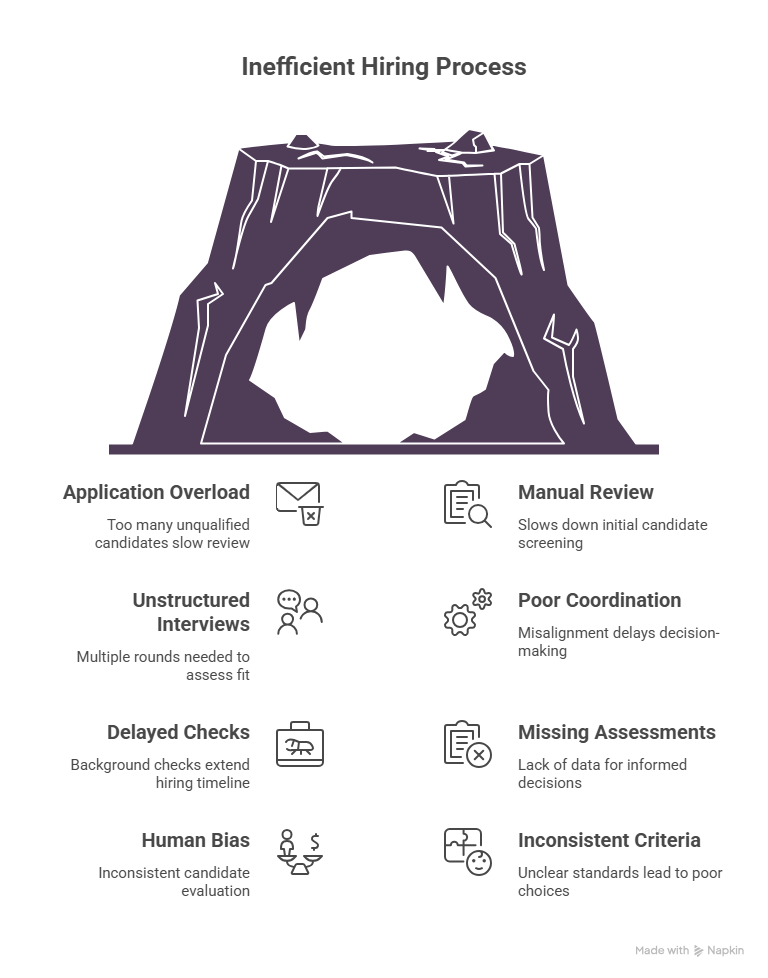
Long time to hire is rarely caused by a lack of candidates. In most cases, it is the result of inefficient processes, unclear evaluation standards, and manual decision making. When recruitment workflows are not structured or supported by automation, delays compound at every stage of the hiring funnel.
What begins as a small screening delay often turns into weeks of lost productivity, frustrated hiring managers, and missed business opportunities.
Below are the most common reasons organizations struggle with prolonged hiring cycles.
Large Volumes of Unfiltered Applications
Digital job boards make it easy for candidates to apply instantly. While this increases applicant volume, it also overwhelms recruiters with irrelevant or underqualified profiles.
Without pre screening filters or structured assessments, teams must manually sort through hundreds of resumes. This slows down shortlisting and increases the risk of overlooking qualified candidates buried in the pile.
Slow Manual Resume Reviews
Resume screening remains one of the most time consuming parts of recruitment. Reviewing resumes manually requires recruiters to interpret job history, validate skills, and assess relevance based on limited information.
Because resumes are formatted inconsistently and often optimized with keywords, identifying genuine capability becomes difficult. Manual review also introduces subjective bias, further complicating decision making and extending evaluation time.
Unstructured Interviews That Require Multiple Rounds
When interviews lack structure, hiring teams often compensate by adding more rounds. Instead of assessing clearly defined competencies in a single structured session, organizations stretch the process across multiple conversations.
This not only delays hiring decisions but also increases candidate drop off rates. Without predefined evaluation criteria, interviews become repetitive rather than decisive.
Poor Coordination Between Hiring Managers and HR
Recruitment delays frequently occur due to misalignment between HR teams and hiring managers. If expectations are unclear or role requirements shift mid process, candidate evaluation must restart.
Scheduling conflicts, delayed feedback, and inconsistent communication further extend time to hire. Without centralized collaboration tools or standardized evaluation metrics, coordination becomes a bottleneck.
Delayed Background Checks
Background verification often begins only after final selection, adding days or even weeks to the timeline. If issues arise during verification, the process must restart with a new candidate, significantly increasing overall hiring duration.
Integrating screening steps earlier in the process can prevent such disruptions.
Lack of Pre Hiring Assessments
When organizations rely solely on resumes and interviews, they often struggle to confidently shortlist candidates. This leads to extended deliberation and additional interview rounds.
Pre hiring assessments help filter candidates early based on skill and role fit. Without them, recruiters spend more time guessing and less time evaluating objectively.
Excessive Reliance on Human Judgment
Human judgment is valuable but inconsistent. Different interviewers may interpret responses differently, leading to conflicting opinions and prolonged discussions before final decisions are made.
Structured evaluation tools reduce ambiguity and enable faster, data backed hiring decisions.
Inconsistent Screening Criteria
When screening criteria are not standardized, recruiters may apply different benchmarks for different candidates. This inconsistency results in repeated evaluations, internal debates, and extended approval cycles.
Clear scoring frameworks and objective testing methods ensure faster and more consistent candidate comparisons.
In most organizations, long time to hire is not a talent shortage problem. It is a process efficiency problem. Structured workflows, standardized assessments, and early stage skill validation significantly reduce delays while improving hiring accuracy.
When these issues persist, recruitment timelines stretch unnecessarily, leading to talent loss, increased hiring costs, and reduced business productivity. Candidates today move quickly; if an organization takes too long to respond, qualified applicants may accept offers from competitors. This makes it essential to reduce time to hire using structured pre-employment screening measures that streamline the initial filtering process.
Time to Fill vs Time to Hire: Understanding the Difference
Many organizations mistakenly use time to hire and time to fill interchangeably, but these metrics measure different aspects of the recruitment process.
Time to hire measures the time between when a candidate applies and when the offer is accepted. It highlights how efficiently an organization screens and evaluates applicants.
Time to fill measures the time between when a job opening is approved and when a candidate accepts the offer. It covers total hiring duration including job posting, sourcing, and pre employment stage actions.
Understanding time to fill vs time to hire helps companies identify delays in the recruitment journey and apply the correct strategies to reduce time to hire effectively.
Differences Between Time to Fill and Time to Hire
| Criteria | Time to Fill | Time to Hire |
|---|---|---|
| Definition | Measures the total number of days it takes to fill a job from the moment the position is approved or posted. | Measures the time from when a candidate enters the pipeline (applies or is sourced) until they accept the job offer. |
| Start Point | Starts when the job requisition is created or published. | Starts when a candidate shows interest or is contacted by the recruiter. |
| End Point | Ends when the candidate officially accepts the offer and the role is marked as filled. | Ends at the moment the selected candidate accepts the offer. |
| Primary Focus | Recruitment cycle efficiency, sourcing cycle speed, and hiring operational performance. | Candidate experience, interview efficiency, assessment effectiveness, and pipeline movement. |
| What It Measures | Total duration of the job vacancy in the organization. | Speed of evaluating and selecting the right candidate. |
| Influenced By | Market talent availability, job description clarity, sourcing channels, employer brand. | Screening process quality, assessment tools, interview scheduling, hiring manager coordination. |
| Used By | HR leaders and workforce planners to analyze hiring delays and talent shortage trends. | Recruiters and hiring managers to track how quickly candidates progress through the pipeline. |
| Objective | Optimize the overall hiring cycle and reduce vacancy costs. | Speed up the selection of the right candidate and improve hiring quality. |
| Impact on Business | Longer time to fill increases business downtime and reduces productivity. | Longer time to hire results in candidate drop-off and loss of top talent. |
| Key Improvement Strategies | Improve sourcing methods, strengthen employer brand, leverage talent pools. | Use pre-employment assessments, automate screening, streamline interviews, enhance communication. |
How Pre Employment Screening Reduces Time to Hire
Pre employment screening plays a crucial role in accelerating recruitment and ensuring fast, high-quality hiring decisions. Below are the major ways pre hiring assessment tools reduce time to hire:
1. Early Elimination of Unqualified Candidates
By filtering candidates at the pre employment stage, organizations prevent inefficiencies caused by screening applicants who don’t meet requirements.
2. Automated Assessments Replace Manual Review
Pre screening tests automate competency validation, reducing hours spent evaluating resumes manually.
3. Shorter Interview Cycles
Because pre hiring assessments validate core skills upfront, fewer interview rounds are required.
4. Better Shortlisting Accuracy
Objective assessment data ensures only the right candidates enter the interview pipeline, cutting wasted interview time.
5. Improved Coordination Between HR and Hiring Managers
Pre employment screening measures create clear evaluation criteria, reducing back-and-forth decision-making.
6. Faster Offer Decisions
When candidate data is thorough and structured, it becomes easier to finalize decisions quickly.
7. Lower Drop-off Rates
Candidates appreciate quick processes and are less likely to disengage or withdraw applications.
These advantages show how screening tests directly contribute to reduced time to hire and strengthen the entire recruitment process.
10 Ways to Reduce Time to Hire
Reducing time to hire is not about rushing candidates through the pipeline. It is about removing friction from every stage of recruitment. When hiring workflows lack structure, clarity, or automation, delays become inevitable. Organizations that consistently hire faster do so because their processes are standardized, measurable, and aligned with business urgency rather than reactive decision making.
Below are ten strategic and operational ways to reduce time to hire without sacrificing quality.
1. Introduce Skill Assessments at the Application Stage
One of the largest delays in hiring occurs during resume screening. Recruiters spend significant time reviewing applications that may not meet the required skill level. By introducing structured skill assessments at the application stage, organizations immediately filter candidates based on actual ability rather than resume presentation.
This approach transforms screening from manual interpretation to data driven evaluation. Instead of debating resumes, hiring teams review performance scores and competency benchmarks, significantly accelerating shortlisting.
2. Replace Redundant Interview Rounds with Structured Evaluation
Multiple interview rounds often signal uncertainty in evaluation. When capability is not validated early, organizations compensate by adding additional interviews. This increases scheduling delays and candidate drop offs.
Pre hiring assessments provide objective clarity before interviews begin. When foundational skills are already verified, interviews can focus on alignment and culture fit, reducing unnecessary rounds and speeding up final decisions.
3. Define Hiring Criteria Before Sourcing Begins
Hiring slows down when expectations are unclear or change mid process. If hiring managers and HR teams are not aligned on success metrics before sourcing begins, candidate evaluation becomes inconsistent and prolonged.
Defining competency frameworks, technical benchmarks, and behavioral expectations upfront ensures faster comparisons and prevents repeated evaluations. Clarity at the beginning eliminates confusion at the end.
4. Build and Maintain Pre Assessed Talent Pools
Organizations that treat each hiring cycle as a fresh search lose valuable time. Maintaining structured talent pools of previously assessed candidates allows recruiters to quickly revisit qualified profiles when new roles open.
Pre assessed databases reduce sourcing time and eliminate repetitive screening, accelerating early stage hiring activities.
5. Automate Administrative Recruitment Tasks
Scheduling interviews, tracking feedback, sending reminders, and coordinating communication consume substantial recruiter time. When handled manually, these tasks create bottlenecks.
Recruitment automation tools streamline coordination and centralize candidate information. Automated workflows reduce dependency on manual follow ups and improve overall hiring speed.
6. Standardize Interview Scorecards and Evaluation Frameworks
Unstructured interviews often lead to inconsistent feedback and prolonged internal discussions. Without standardized criteria, interviewers apply different benchmarks, making consensus difficult.
Structured scorecards aligned with role competencies enable objective comparisons. When candidates are evaluated using the same scoring system, decision making becomes faster and more consistent.
7. Fast Track High Performing Candidates
Not all candidates require the same pace of evaluation. When assessments clearly identify high performers, organizations should prioritize their progression through the hiring pipeline.
Fast tracking strong candidates prevents losing top talent to competitors and shortens overall time to hire.
8. Improve Hiring Manager Accountability and Feedback Timelines
Delays frequently occur when feedback from hiring managers is slow or inconsistent. Without clear expectations, candidate evaluations remain pending.
Establishing defined feedback timelines and accountability measures ensures quicker responses and smoother candidate progression.
9. Initiate Background Verification Strategically
Background checks often extend hiring timelines because they begin only after final selection. If complications arise, the process must restart.
Starting verification earlier for shortlisted candidates prevents last minute delays and reduces risk while maintaining compliance.
10. Adopt a Data Driven Hiring Model
Organizations that rely heavily on subjective judgment often take longer to make decisions. Internal debates and differing opinions extend approval cycles.
A data driven hiring model supported by structured assessments and measurable performance indicators accelerates decision making. When candidate capability is quantified, confidence in final selection increases and timelines shorten.
Reducing time to hire is not about compromising standards. It is about creating structured systems that eliminate inefficiencies. Organizations that validate skills early, automate coordination, and align evaluation criteria consistently hire faster while maintaining high performance standards.
Reduced Time to Hire: Business Impact
Reduced time to hire has a profound impact on business performance. Organizations that optimize time to hire experience:
Faster onboarding
Enhanced productivity
Lower recruitment costs
Better candidate experience
Higher offer acceptance rates
Lower likelihood of talent loss to competitors
Improved employer brand perception
Reduced time to hire benefits not only HR efficiency but overall organizational output.
TAT for Recruitment: Why It Matters
Turnaround time (TAT for recruitment) refers to the duration required to complete all hiring activities. Long TAT negatively impacts productivity, hiring quality, and candidate experience. Pre employment screening significantly reduces TAT by accelerating evaluation, decision-making, and onboarding alignment.
Organizations with optimized TAT enjoy smoother workforce planning, faster team expansion, and reduced operational strain.
Developing Effective Pre Hiring Assessment Workflows
Developing a pre hiring assessment strategy involves choosing the right mix of technical, behavioral, cognitive, and practical assessments. The workflow includes:
Defining competency frameworks
Selecting assessment tools
Designing standardized scoring models
Creating automated shortlisting rules
Integrating assessments with ATS systems
Training hiring teams for consistency
A strong pre hiring assessment workflow ensures precision, consistency, and speed.
The Role of Digital Tools in Reducing Time to Hire
Digital tools have transformed how organizations reduce time to hire. Automated assessment platforms streamline evaluation and free HR teams to focus on strategic tasks. AI-driven scoring detects patterns, eliminates manual review, and ensures accuracy. Online proctoring secures remote tests. Automated scheduling tools coordinate interviews seamlessly.
Digitalization creates accelerated hiring cycles, reduces human error, and increases hiring accuracy.
How Skillrobo Enhances Pre Employment Screening and Reduces Time to Hire
Skillrobo offers comprehensive solutions that optimize pre employment screening and drastically reduce time to hire. The platform supports:
Customizable pre screening assessments
AI-driven scoring and automated shortlisting
Instant test results and detailed skill reports
Remote proctoring for assessment integrity
Role-based competency mapping
Fast candidate filtering
Integration with ATS systems

By automating early-stage evaluation, Skillrobo helps organizations hire faster, smarter, and with higher confidence.
Wrapping Up
Pre employment screening is one of the most powerful strategies to reduce time to hire without compromising quality. By implementing structured pre screening assessments, organizations enhance hiring accuracy, eliminate manual bottlenecks, and accelerate decision-making. A well-designed pre employment stage improves candidate experience, reduces recruitment turnaround time, and builds stronger, future-ready teams. With digital tools like Skillrobo, companies can fully transform their recruitment pipeline, reducing hiring time by days or even weeks while maintaining data-driven precision in selection.
FAQs
What does pre screening test mean in pre-employment?
A pre screening test is an early-stage assessment used to filter candidates before interviews. It verifies basic skills, role fit, and job suitability, ensuring only qualified applicants advance in the hiring process.
How do pre-employment screening measures reduce time to hire?
Pre-employment screening measures reduce time to hire by automating early evaluations, eliminating unqualified candidates, shortening interview cycles, and improving accuracy in shortlisting. This minimizes delays and speeds up recruitment.
What is the difference between time to fill vs time to hire?
Time to hire tracks the time from when the candidate applies to when they accept the offer, while time to fill measures the entire hiring duration from job posting to offer acceptance. Both metrics help identify hiring bottlenecks.
What are the best ways to reduce time to hire?
Organizations can reduce time to hire by automating assessments, improving communication, using pre-screening tests, reducing interview rounds, leveraging talent pools, and aligning HR and hiring managers through collaborative tools.
How can Skillrobo help organizations hire faster?
Skillrobo offers pre-employment assessments, AI-driven scoring, automated shortlisting, skill mapping, and real-time analytics. These capabilities significantly reduce time to hire by streamlining the pre employment stage and improving decision-making accuracy.